 CALCULATE MY SCORE
AFT Calculator 2026 – Army Fitness Test Score Calculator
Calculate your score for all five current Army Fitness Test events using the Army's published point-by-point AFT scoring scales. Select your age, sex and AFT standard to see individual event scores, your total out of 500, pass/fail status and a separate Combat-standard check.
3-Rep Max Deadlift (MDL)
Hexagonal trap bar; 3 continuous repetitionsHand-Release Push-Ups (HRP)
2 minutes; full arm extension at bottomSprint-Drag-Carry (SDC)
5x50m shuttle: sprint, 90-lb sled, lateral, 40-lb KBs, sprintPlank (PLK)
Forearm isometric hold; straight line maintenance2-Mile Run (2MR)
Measured two-mile route on a level field, track or running surfaceWhat Is the Army Fitness Test (AFT)?
The Army Fitness Test, or AFT, is the U.S. Army's current physical fitness test of record. It replaced the six-event Army Combat Fitness Test on June 1, 2025 and consists of five scored events: the Three-Repetition Maximum Deadlift (MDL), Hand-Release Push-Up (HRP), Sprint-Drag-Carry (SDC), Plank (PLK), and Two-Mile Run (2MR). Each event can contribute up to 100 points, for a maximum AFT score of 500 points.
The five events measure different parts of physical readiness rather than a single type of fitness. The MDL assesses muscular strength; the HRP emphasizes upper-body muscular endurance; the SDC tests muscular strength and endurance together with anaerobic power and endurance; the Plank measures core muscular endurance; and the 2MR measures aerobic endurance.
The change from the ACFT to the AFT was more than a name change. The Standing Power Throw was removed from the record test, reducing the scored battery from six events to five, and the Army introduced a higher sex-neutral scoring standard for designated combat specialties. The Army states that performance data from nearly one million ACFTs, together with RAND analysis, informed the transition.
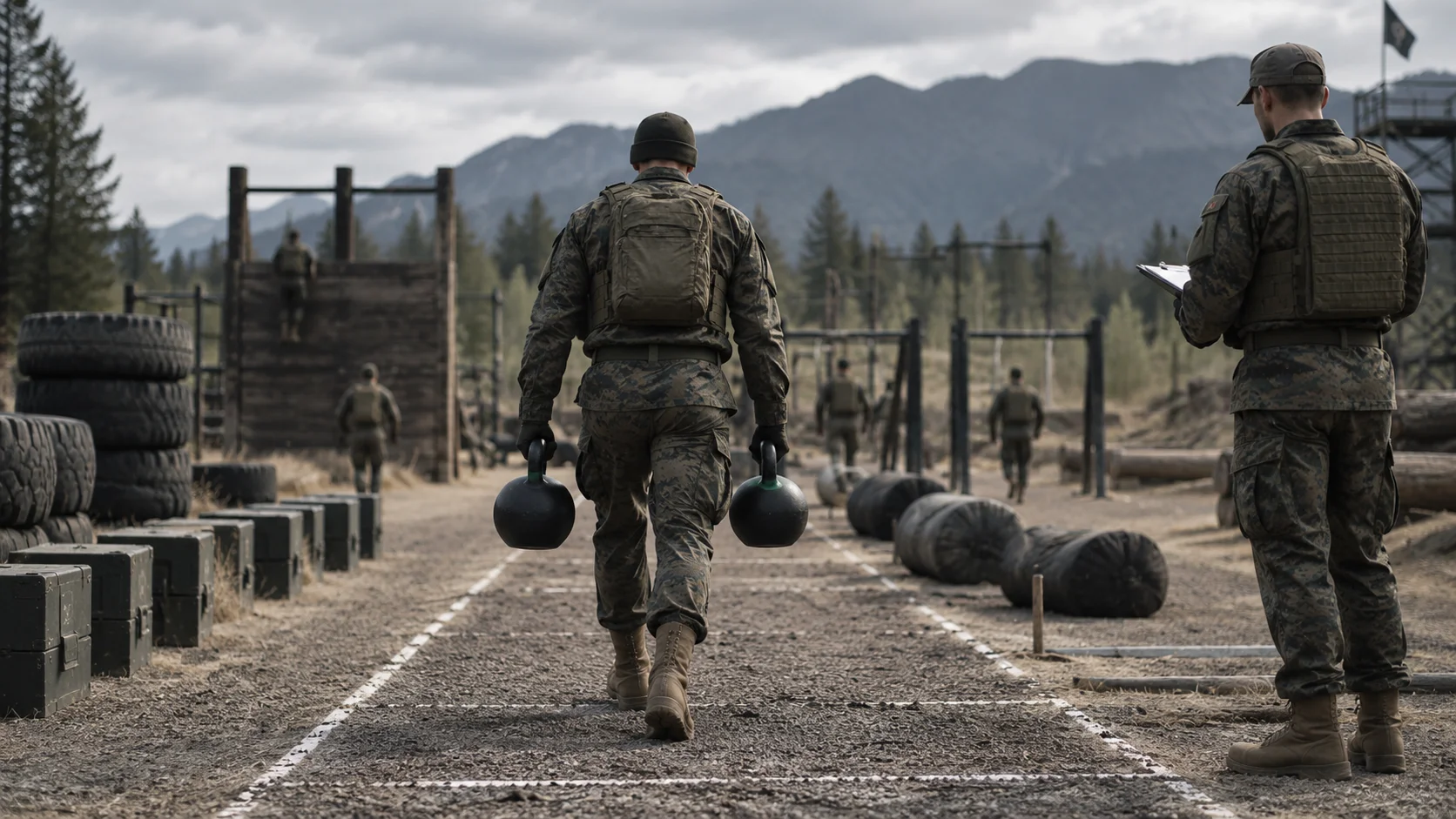
The AFT remains the Army's fitness test of record. Army Directive 2026-07 also established the separate Combat Field Test for 24 designated combat specialties. The CFT complements the AFT and does not replace it.
How the AFT Scoring System Works
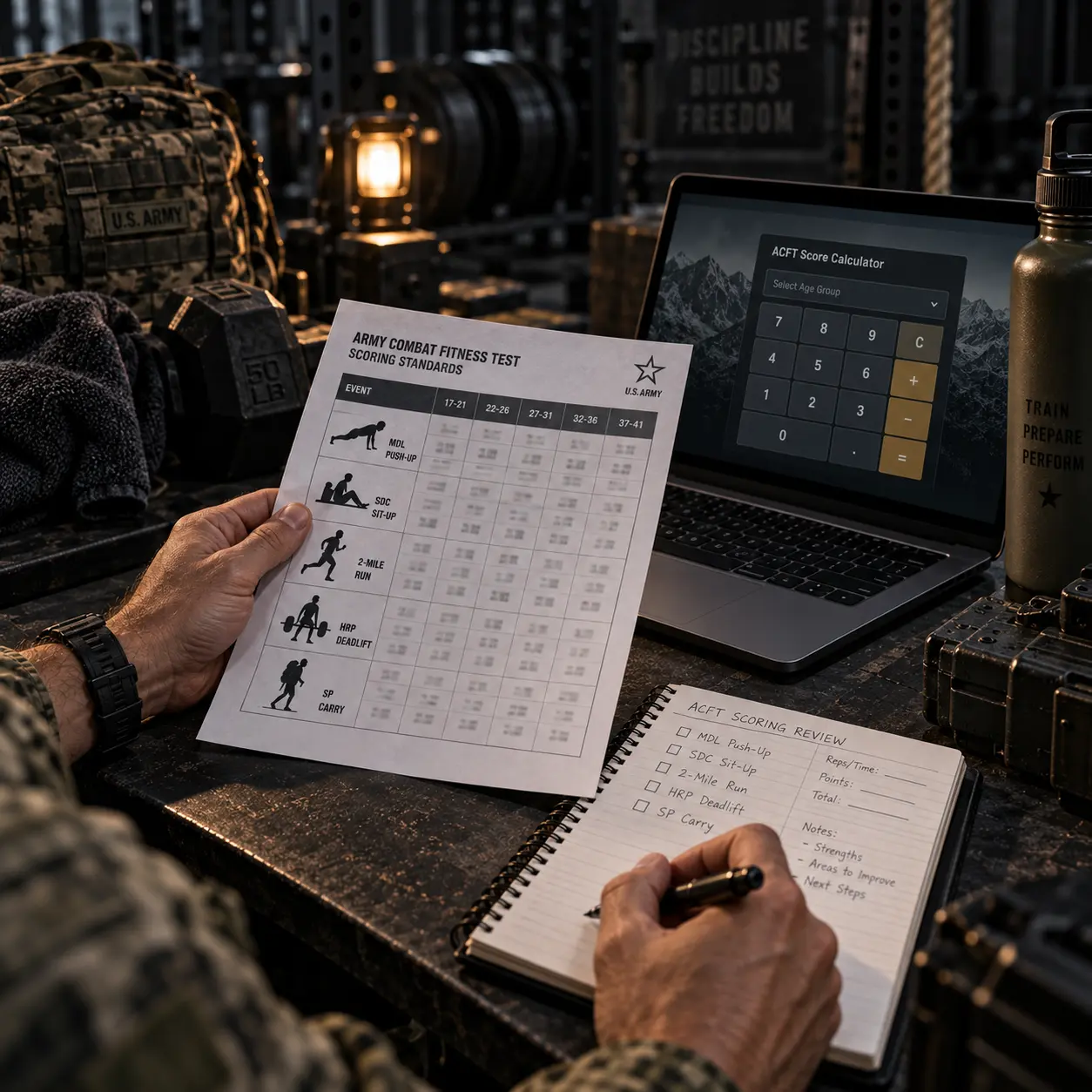
Every AFT event produces a raw performance first: pounds lifted for the MDL, correctly completed repetitions for the HRP, or elapsed time for the SDC, Plank and 2MR. That raw result is then matched against the Army's published scoring table for the Soldier's age group and applicable scoring column. Each event is worth 0 to 100 points, so a complete five-event AFT has a maximum score of 500.
This calculator uses the Army's published point-by-point thresholds rather than estimating scores between a 60-point minimum and a 100-point maximum. That distinction matters because the official tables are not mathematically linear. Some adjacent point rows share a performance threshold or contain no separate raw-performance value, so an interpolated score can be wrong even when the 60-, 70- and 100-point benchmarks are correct.
What Do M/C and F Mean on the AFT Score Tables?
The Army scoring tables use an M/C column and an F column within each age bracket. M/C is used for male General scoring and for the sex-neutral Combat standard. F is the Female column used for General-standard scoring.
The Combat standard remains age-normed but sex-neutral. This means a female Soldier's General score and Combat-standard score can differ even when the raw event performances are identical.
General AFT Standard
For the General standard, a Soldier must score at least 60 points in every event and at least 300 points overall. General scoring is normed by age and sex.
Combat AFT Standard
For Soldiers in designated combat specialties, the AFT Combat standard requires at least 60 points in every event and at least 350 points overall. Combat scoring is age-normed and sex-neutral.
A Combat Soldier does not need 70 points in every individual event. A 350-point total across five events is mathematically a 70-point average, but the individual-event minimum remains 60.
Worked AFT Score Example
For a Soldier age 22–26 using the M/C scoring column:
| Event | Raw Performance | AFT Points |
|---|---|---|
| 3-Rep Max Deadlift (MDL) | 240 lb | 79 |
| Hand-Release Push-Up (HRP) | 39 reps | 82 |
| Sprint-Drag-Carry (SDC) | 2:30 | 60 |
| Plank (PLK) | 2:10 | 74 |
| 2-Mile Run (2MR) | 18:55 | 66 |
| Total | — | 361 / 500 |
This example passes the General standard and also reaches the 350-point Combat total while maintaining at least 60 points in every event. The values come from the Army's published point-by-point scoring scales rather than a percentage conversion.
Why Female General and Combat Scores Can Differ
The same raw performances can produce a different General score for a female Soldier because the Female General scoring column differs from the M/C column. For a female Soldier age 22–26, the same 240 lb MDL, 39 HRP, 2:30 SDC, 2:10 Plank and 18:55 2MR performances produce 431/500 under Female General scoring. Re-scoring those same raw performances under the M/C Combat standard produces 361/500.
That is why the Combat Standard Check must re-score the raw performances rather than simply reuse the General total.
General vs Combat AFT Standards: Which One Applies?
Most Soldiers use the General AFT standard. Soldiers serving in specifically designated combat AOCs/MOSs use the higher Combat AFT standard.
| Requirement | General Standard | Combat Standard |
|---|---|---|
| Scoring basis | Age- and sex-normed | Age-normed, sex-neutral |
| Minimum per event | 60 points | 60 points |
| Minimum total | 300 / 500 | 350 / 500 |
| Scoring column | M/C for male, F for female | M/C for everyone |
| Who it applies to | Other Army specialties | 21 designated AFT combat specialties |
As of September 2026, the AFT Combat standard applies to the 21 AOCs/MOSs below. The separate CFT population contains 24 specialties because it also includes 12D, 89D and 89E.
Current 21 AFT Combat Specialties
Important 2026 Combat Field Test Requirement
Army Directive 2026-07 established the Combat Field Test, or CFT, for a separate 24-specialty population: the 21 listed above plus 12D, 89D and 89E. The CFT does not replace the AFT.
The CFT consists of seven events performed continuously: a one-mile run, 30 dead-stop push-ups, a 100-meter sprint, 16 lifts of a 40-pound sandbag onto a 65-inch platform, a 50-meter carry using two 5-gallon Army water cans weighing 40 pounds each, a 50-meter movement drill, and a final one-mile run. The current passing standard is completion of the entire sequence in 30 minutes or less.
The implementation period began April 17, 2026. During the one-year transition period, no administrative action is taken solely because of a failed CFT. Full implementation begins 365 days after Army Directive 2026-07.
The Five Army Fitness Test Events
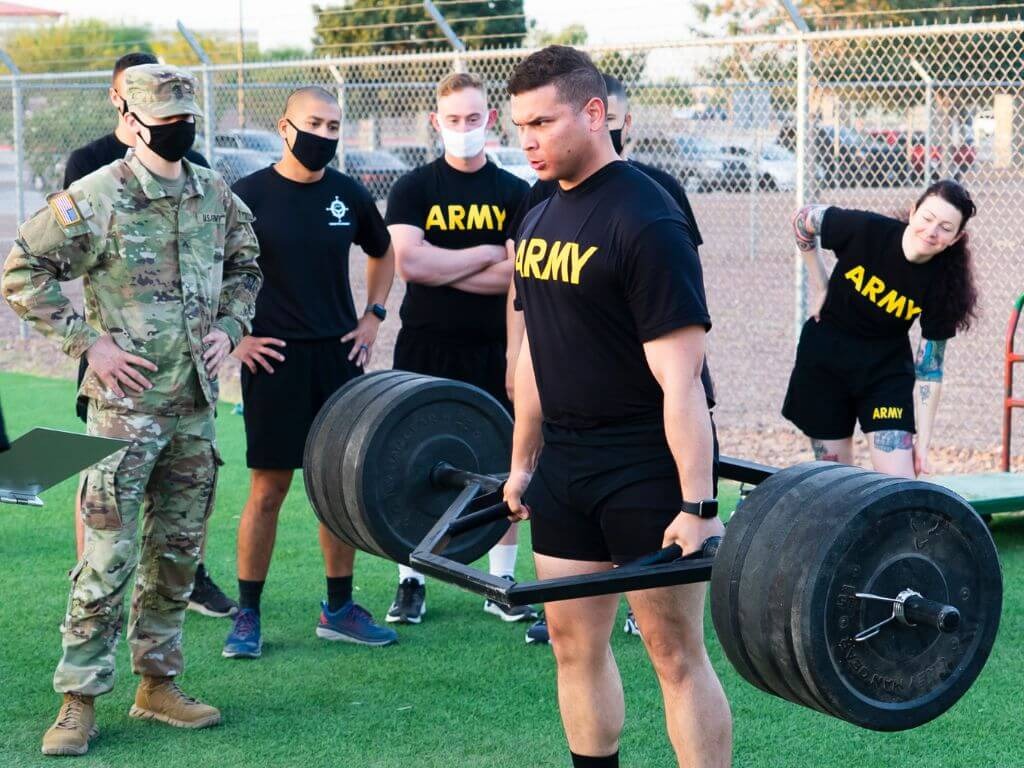
1. Three-Repetition Maximum Deadlift (MDL)
The MDL measures muscular strength. The Soldier completes three continuous repetitions with the hexagonal or trap bar, and the successfully completed load becomes the raw performance used for scoring.
The event places substantial demand on the lower body, posterior chain, grip and trunk. Higher successfully completed loads earn more points according to the Soldier's age group and applicable scoring column.
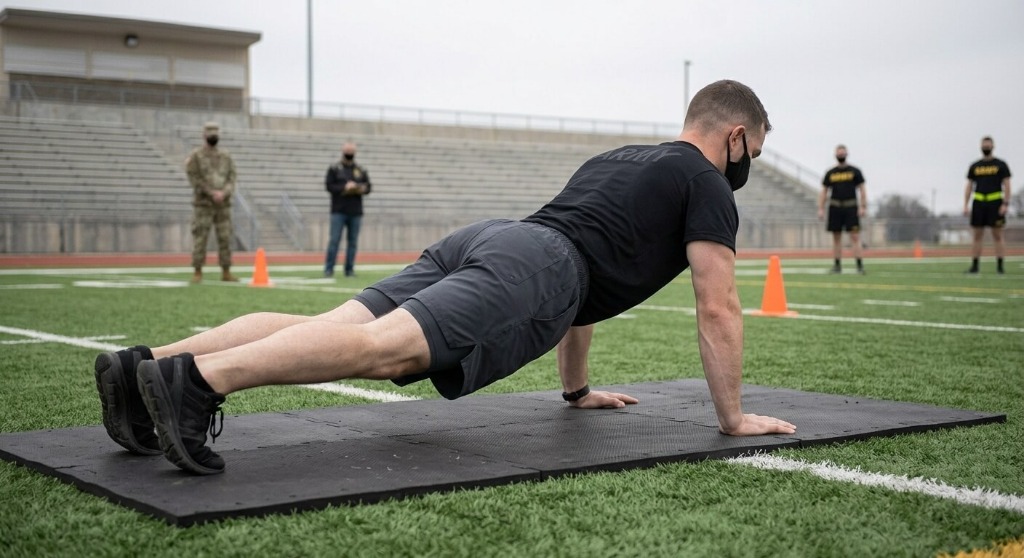
2. Hand-Release Push-Up (HRP)
The HRP is a two-minute repetition event that measures upper-body muscular endurance. Each repetition must meet the Army's movement standard, including the required hand and arm movement at the bottom position.
The raw score is the number of correctly completed repetitions within two minutes.
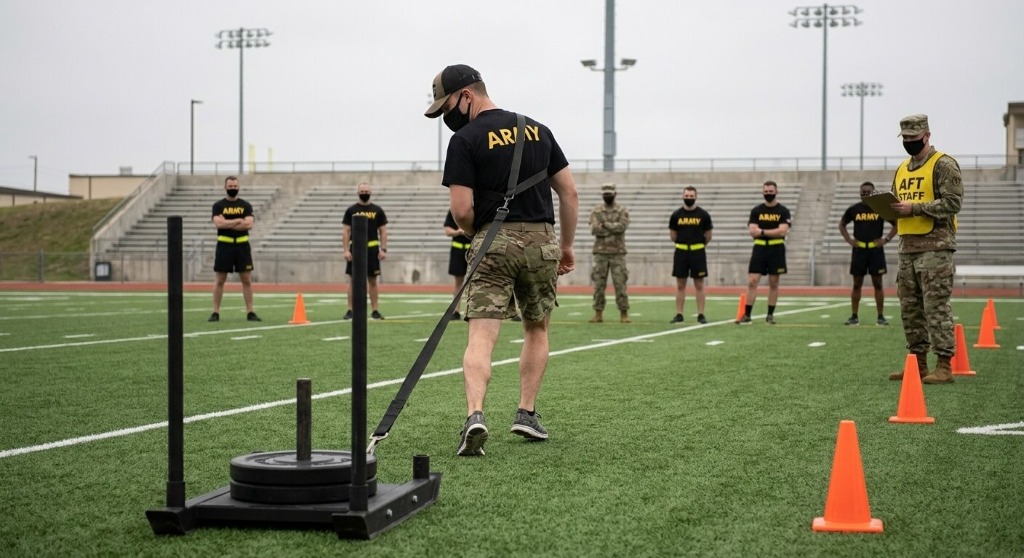
3. Sprint-Drag-Carry (SDC)
The SDC is a 250-meter shuttle event made up of five 50-meter movements: sprint, sled drag, lateral movement, kettlebell carry and a final sprint. Army-standard equipment includes a 90-pound sled and two 40-pound kettlebells.
The event assesses muscular strength and endurance together with anaerobic power and anaerobic endurance. Faster completion times earn higher scores.
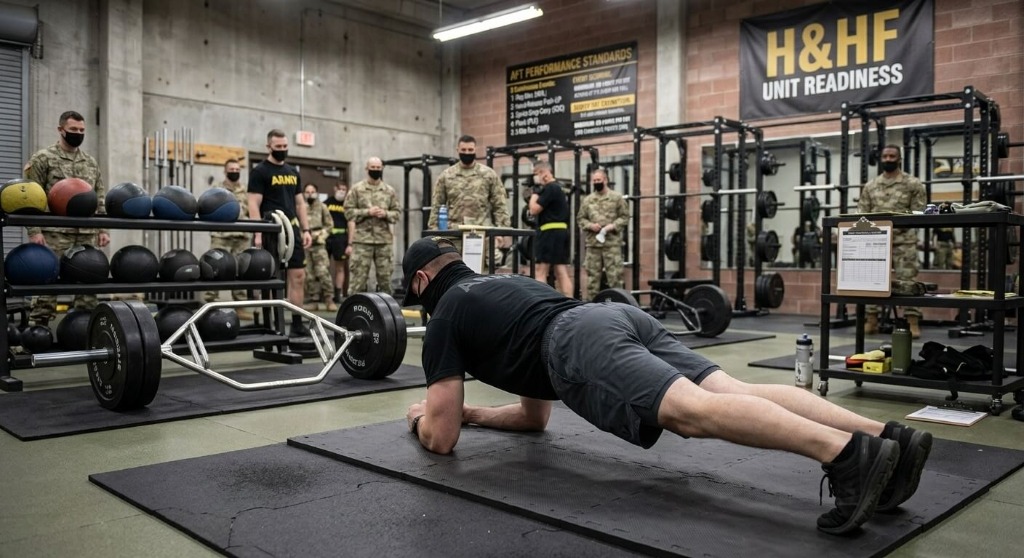
4. Plank (PLK)
The Plank is the AFT's core muscular-endurance event. The Soldier maintains the required forearm plank position while keeping the head, shoulders, back, hips and legs in a straight-line position from head to heels.
Longer valid hold times earn higher scores. The Army scoring table contains some point rows without a separate published Plank time, so this calculator follows the actual listed thresholds rather than inventing intermediate scores.
For example, in the age 22–26 M/C column, 1:25 earns 60 points. The next listed sub-60 performance, 1:24, earns 58 points.
5. Two-Mile Run (2MR)
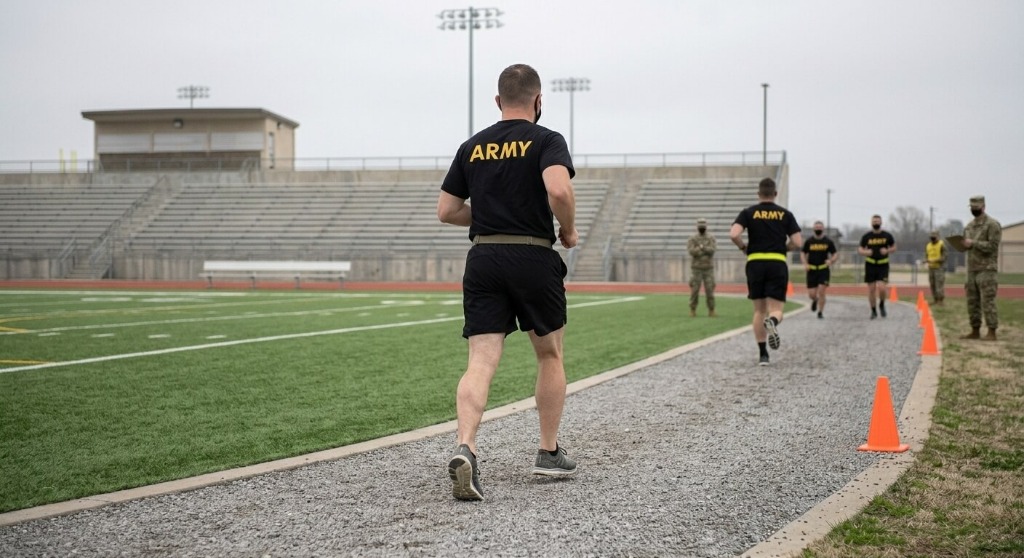
The 2MR measures aerobic endurance. Soldiers run two miles for time on an authorized measured running surface. Faster valid completion times earn higher scores.
Aerobic endurance supports a Soldier's ability to sustain physical work for longer periods and recover between repeated physical tasks.
AFT Alternate Events for Soldiers on a Medical Profile
Alternate aerobic events are not optional substitutes for a Soldier who simply prefers not to run. They are used when authorized under the Soldier's medical-profile requirements.
The current AFT provides four alternate aerobic endurance events:
- 5,000-meter row
- 12,000-meter stationary bike
- 1,000-meter swim
- 2.5-mile walk
These alternate aerobic events are evaluated as GO/NO-GO rather than as ordinary 0-to-100 point replacements for the Two-Mile Run. Passing times vary by age group and applicable M/C or Female scoring column.
Permanent-profile rules can also affect how the overall AFT standard is applied. The Army's AFT guidance states that Combat-standard Soldiers with permanent profiles must meet the required average across the primary events they are authorized to perform and pass the alternate aerobic event when one is required.
AFT vs ACFT vs CFT: Know the Difference
| Test | Status in September 2026 | Who It Applies To | Format |
|---|---|---|---|
| AFT | Current Army fitness test of record | Soldiers under current Army testing policy | 5 scored events, maximum 500 points |
| ACFT | Legacy test; record testing ended May 31, 2025 | Historical / legacy records | 6 scored events, including the Standing Power Throw |
| CFT | New 2026 combat-specialty requirement in implementation period | 24 designated combat specialties | 7 continuous events, pass/fail, 30-minute standard |
The Standing Power Throw belongs to the legacy ACFT, not the current five-event AFT. The Army ended ACFT record testing after May 31, 2025 and made the AFT the test of record on June 1, 2025.
The Combat Field Test is also not a replacement for the AFT. Army Directive 2026-07 specifically establishes the CFT as an additional requirement for designated combat specialties.
A High AFT Score Does Not Exempt You From Army Body Composition Standards
Army body-composition policy changed significantly in July 2026. Army Directive 2026-13 made waist-to-height ratio, or WHtR, the Army's sole authorized body-composition assessment and replaced the previous height-and-weight screening tables, circumference-based tape test and supplemental body-fat assessments.
The current compliance standard is a WHtR of less than, but not equal to, 0.55. WHtR is recorded to three decimal places without rounding. Any digits after the third decimal place are disregarded. That means .549 passes, while .550 fails.
Waist circumference is measured at the navel in inches and divided by height in inches:
A WHtR of 0.500 is below the 0.550 cutoff.
All Soldiers are screened at least twice per calendar year. If the initial measurement does not meet the standard, a confirmation measurement is conducted on the same duty day by a different team.
A Soldier's AFT score does not create an exemption from the WHtR requirement.
AFT Minimum Passing Benchmarks: Quick Reference
These are the 60-point raw-performance thresholds from the current Army scoring scales for the first two age brackets. M/C means the Male/Combat column; F means Female General scoring.
| Event | 17–21 M/C | 17–21 F | 22–26 M/C | 22–26 F |
|---|---|---|---|---|
| 3RM Deadlift | 150 lb | 120 lb | 150 lb | 120 lb |
| Hand-Release Push-Up | 15 reps | 11 reps | 14 reps | 11 reps |
| Sprint-Drag-Carry | 2:28 | 3:15 | 2:31 | 3:15 |
| Plank | 1:30 | 1:30 | 1:25 | 1:25 |
| 2-Mile Run | 19:57 | 22:55 | 19:45 | 22:45 |
Under the General standard, five 60-point event scores produce the minimum 300/500 passing total. A Combat-standard Soldier must still reach at least 350 overall, so five 60-point performances would not satisfy the Combat total requirement.
More Army Fitness Tools
AFT Score Chart
Look up raw-performance thresholds from 0 to 100 points across current AFT age groups and scoring columns.
View AFT Score Chart →AFT Passing Standards
Compare minimum event thresholds and understand the difference between the 300-point General and 350-point Combat standards.
View AFT Passing Standards →2-Mile Run Pace Calculator
Convert a target 2MR finish time into mile pace, 400-meter lap splits and checkpoint targets.
Calculate 2-Mile Run Pace →Deadlift Plate Calculator
Build a target trap-bar load from the plates available to you and check the weight loaded on each side.
Calculate Deadlift Plates →