DA Form 705-AFT Guide: Check Your Current Scorecard
Reviewed and updated October 6, 2026 · Current U.S. Army sources

The current AFT scorecard is DA Form 705-AFT, April 2026. If you’ve been searching for DA Form 705-TEST, that older identifier is now inactive in the Army Publishing Directorate’s records. Using the current form helps you check the right events, standard and recorded results.
You can use our AFT calculator to compare your raw performances with their point values. The official scorecard also needs the test details, grader initials and required signatures, which a calculator printout doesn’t replace.
Use the Current DA Form 705-AFT
The official DA Form 705-AFT record lists the April 1, 2026 edition as active. Its PDF is available from that record. APD advises saving it locally. You can then open the saved file in Adobe Acrobat or Reader, which helps you view the form properly and check the edition before completing it.
The two-page scorecard has spaces for four tests, each with a date, AOC/MOS, pay grade, age and standard selection, while your name, unit/location and sex appear at the top.
Your age belongs to the specific test you’re reviewing. For example, if you turn 22 between two tests, you’ll move from the 17–21 band into the 22–26 band even when both are recorded on the same form. Copying the earlier group would select the wrong column. The date helps you distinguish the results when comparing their points.
Check the Five Raw Results First
The current form separates your raw performance from the points it earns and includes grader initials at each event, so you can review both entries together. The units help you identify which performance belongs in each box:
| Event | Raw result to review |
|---|---|
| Three-repetition maximum deadlift | Attempt weights in pounds and heaviest successful weight |
| Hand-release push-up | Correctly performed repetitions |
| Sprint-drag-carry | Overall time in minutes and seconds |
| Plank | Duration in minutes and seconds |
| Two-mile run | Overall time in minutes and seconds |
For a deadlift, your recorded weight represents the successful three-repetition attempt, so a successful 240-pound lift stays 240 pounds in the raw result rather than becoming 720 pounds. And a run recorded as 18:55 means 18 minutes, 55 seconds; entering it as 18.55 decimal minutes would describe a different performance and could change the points.
When you find a wrong raw entry, that is the detail to raise with your grader before recalculating points, because the calculation depends on the performance entered.
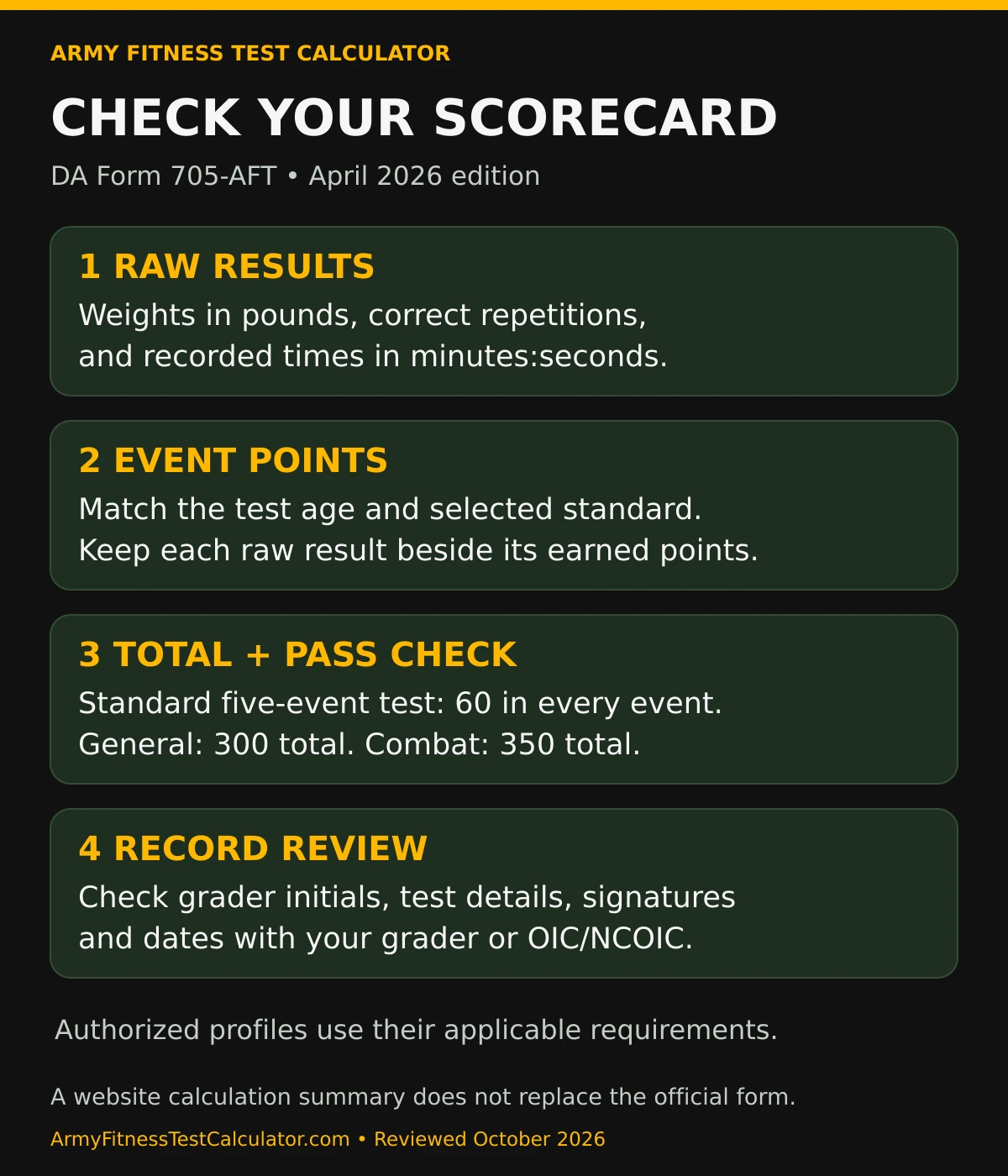
Match the Points to the Selected Standard
Your raw results are converted using the age group and standard for that test. General scoring uses age and sex. Combat scoring is age-normed and sex-neutral, which affects the column you use even when the raw performance stays the same. Our guide to how AFT event points are scored shows how to read that column.
The Army’s current AFT guidance requires at least 60 points in every required event, with standard five-event totals of at least 300 for General and 350 for Combat.
For instance, 89 + 81 + 60 + 60 + 60 equals 350. That breakdown clears both total requirements. A breakdown of 89 + 82 + 60 + 60 + 59 also totals 350, but the final event fails. Your GO/NOGO result therefore needs to agree with the individual scores as well as the addition.
Keep Profile and Body-Composition Records Clear
The scorecard includes an alternate aerobic event area for the authorized row, swim, bike or walk, with its time and GO/NOGO result. If you’ve taken an authorized alternate, your approved profile gives your unit the basis for interpreting that result alongside any blank standard-event boxes.
Under Combat profile rules, your required scored events must average at least 70 points, with the alternate aerobic event passed when required; your unit can confirm how this applies to your profile.
And body composition has a separate record. Our 2026 Army tape-test guide explains the current waist-to-height ratio assessment and DA Form 5500, which you need to establish compliance with that standard.

Review the Record Before You Sign
Your review starts with the raw results recorded by the graders, followed by the event points, total and selected standard. Each event has a grader-initials space, while the test has Soldier and OIC/NCOIC signature and date areas that you’ll also need to review.
A discrepancy belongs with the grader or OIC/NCOIC while your test record can be reviewed. Your unit’s normal process will determine how you retain a personal copy. That copy becomes a useful reference for your next test, especially if you want to compare a particular event rather than a remembered total.
Frequently Asked Questions
Is the Website’s Printed Summary the Official Scorecard?
The website printout is a personal calculation summary; your official test record uses the current Army form, recorded performances and your unit’s normal recording process.
Does the Current Form Include the Standing Power Throw?
DA Form 705-AFT records the five current AFT events and an alternate aerobic event area. The standing power throw belonged to the older ACFT.
Can I Replace a Missing Event With an Assumed Score?
Your unit should confirm why the entry is missing and how your profile or test circumstances apply. An assumed score would change your result without a recorded performance behind it.