How the AFT Is Scored: Read Your Event Points
Reviewed and updated October 6, 2026 · Current U.S. Army sources

The AFT has five events worth up to 100 points each, for a maximum total of 500. Your raw results earn points from the scoring table for your age and applicable standard, while passing also depends on each event meeting its minimum.
If you have your results, our AFT calculator can check the total. This guide explains how the AFT is scored and what to look for when reading your scorecard.
How the AFT Is Scored by Age and Standard
General-standard scoring uses your age group and sex, while Combat-standard scoring uses the same age-normed standard for men and women. Your choice determines the scoring column for all five events, so it’s the first detail to confirm when a point value differs from what you expected.
In the official tables, M/C identifies the male General and Combat column, while F identifies the female General column.
For example, a woman using the Combat standard reads the M/C column for her age group, even though an F column is available beside it. Selecting F would give her a General-standard result and could change the points awarded for the same performance. Your unit can confirm which standard applies to your specialty and record test.
Our AFT score chart organizes the event thresholds by age and standard. Match your age group before looking across to the raw result; switching columns halfway through the five events can produce a plausible-looking total that uses inconsistent standards.
Match the Threshold You Actually Earned
The official AFT scoring scales list the performance needed for each score. Deadlift weight, push-up repetitions and plank duration generally earn more points as they increase. Sprint-drag-carry and two-mile run times earn more points as they decrease.
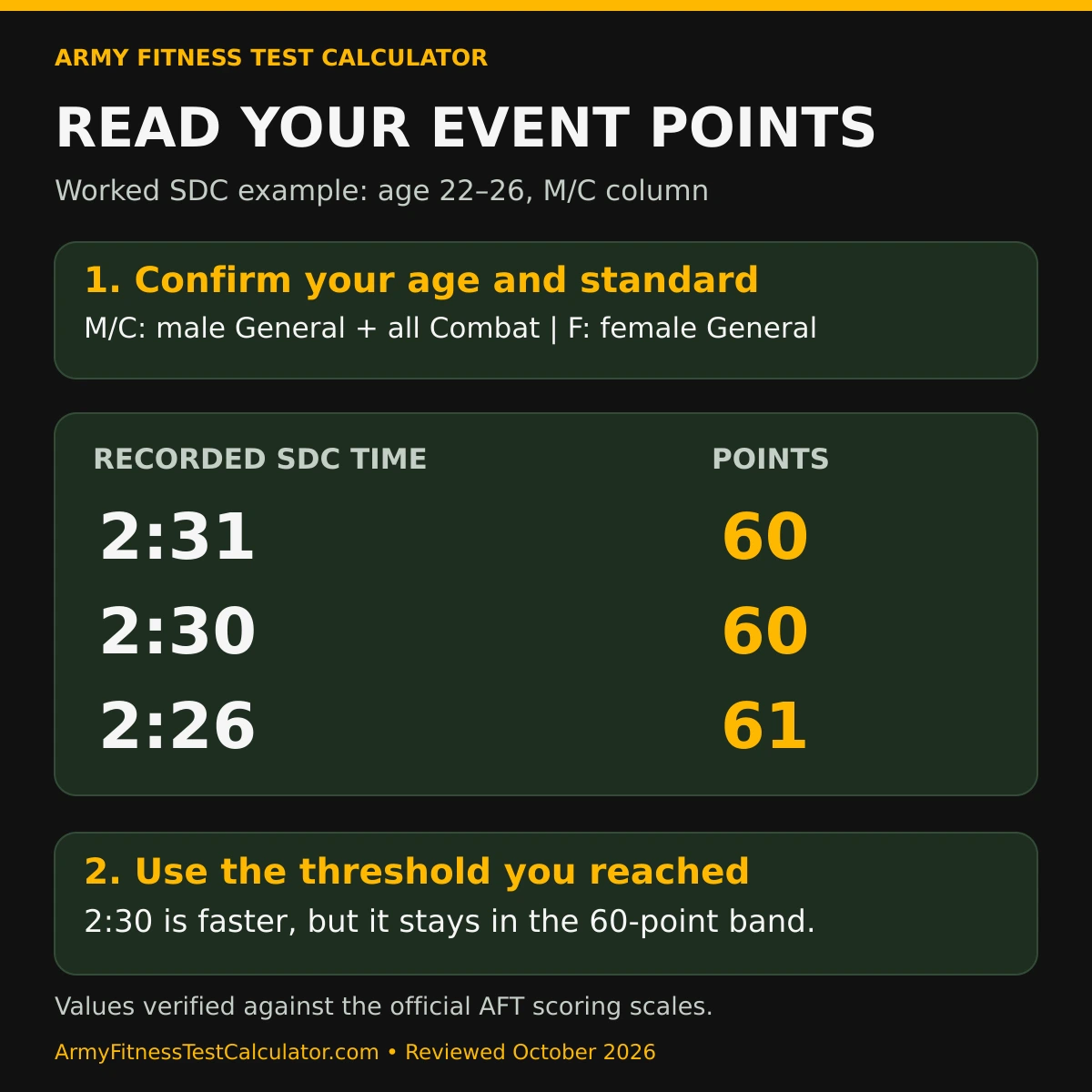
For instance, in the age 22–26 M/C sprint-drag-carry column, 2:31 earns 60 points and 2:26 earns 61. A recorded 2:30 is faster than the 60-point threshold but hasn’t reached the 61-point threshold, so it still earns 60.
| Recorded SDC time | Points in this column | What it means |
|---|---|---|
| 2:31 | 60 | Meets the event minimum |
| 2:30 | 60 | Faster, within the same points band |
| 2:26 | 61 | Reaches the next listed threshold |
Your recorded performance stays intact when you check it, and the points come from the threshold you reached, without a fractional award between those rows.
Check Each Event Before the Total
For a standard five-event test, the General passing requirement is at least 300 total points with at least 60 in every event. Combat requires at least 350 total points, also with at least 60 in every event. These requirements appear on the Army’s AFT page.
Suppose your event scores are 89, 81, 60, 60 and 60. They add up to 350, and every event meets its minimum, so that breakdown meets both total standards. Changing the second event to 82 and the final event to 59 keeps the total at 350 but leaves one event below its minimum. The result fails despite the unchanged total.
That distinction matters when checking your scorecard or choosing your next training goal, because a strong deadlift can increase the total while your run at 60 remains close to its event minimum.
Profiles Can Change the Passing Check
An authorized permanent profile may exempt you from particular events and require an alternate aerobic event. General-standard Soldiers must meet the required event minimums and pass their authorized alternate event when applicable. Under the Combat standard, the required scored events must also average at least 70 points.
For example, four required scored events totaling 280 average 70. Three totaling 210 also average 70. Those averages help explain the Combat requirement. Your approved profile determines which events you take and gives your unit the basis for interpreting an omitted event, rather than filling it with an assumed score.

Compare the Table With Your Recorded Result
When your point total looks wrong, checking the raw performance, age group and standard helps you find whether the problem is an entry, a column choice or the addition itself.
Our current AFT scorecard guide explains what to review on the official form. Check the time format as well as the value. For example, 18:55 means 18 minutes and 55 seconds. If you dispute the performance recorded by your grader, bring that question to your unit so the original entry can be reviewed.
Frequently Asked Questions
Does a 350 Total Mean You Earned 70 in Every Event?
A 350 means the five scores average 70, and your individual scores can vary considerably. The event breakdown shows which performances contribute most to your total and which sit close to their minimums.
Can You Carry a Six-Event ACFT Total Into the AFT?
The current AFT’s five events and 500-point maximum differ from the older six-event ACFT, so an old total doesn’t transfer directly into the current score.
Does 400 Out of 500 Mean the 80th Percentile?
A 400 means 80% of the maximum available points. To establish a percentile, you would need a score distribution for the group you’re comparing with, beyond the thresholds in the scoring table.