Army Tape Test in 2026: Waist-to-Height Ratio
Reviewed and updated October 6, 2026 · Current U.S. Army sources
The Army tape test in 2026 uses waist-to-height ratio, or WHtR, and your recorded result must be below 0.550 to meet the July 2026 standard. Older body-fat formulas and height-and-weight screening tables have been replaced.
Our Army tape test calculator can help you estimate your ratio. However, the measurement method and recording rules matter, especially near the cutoff, so it’s useful to understand how the official assessment works before comparing results.
What Is the Current Army Tape-Test Standard?
Army Directive 2026-13 establishes WHtR as the Army’s sole body-composition assessment, calculated by dividing your average waist measurement in inches by your height in inches:
WHtR = average waist circumference ÷ height
Your waist is measured at your navel, or belly button, so measuring where your trousers sit or choosing the narrowest part of your torso can give you a different result.
The same ratio threshold applies to men and women, and your age doesn’t change it. Screening is required at least twice per calendar year. Commanders may also direct an assessment when they have concerns about compliance, so your next measurement may occur outside the two routine screenings.
Measure and Record It the Army’s Way
The EXORD 182-26 measurement guidance sets out the positions and rounding rules that your official measurement team uses:
- Height: measured in socks without shoes, standing straight with your head level; the measurement is rounded to the nearest half inch.
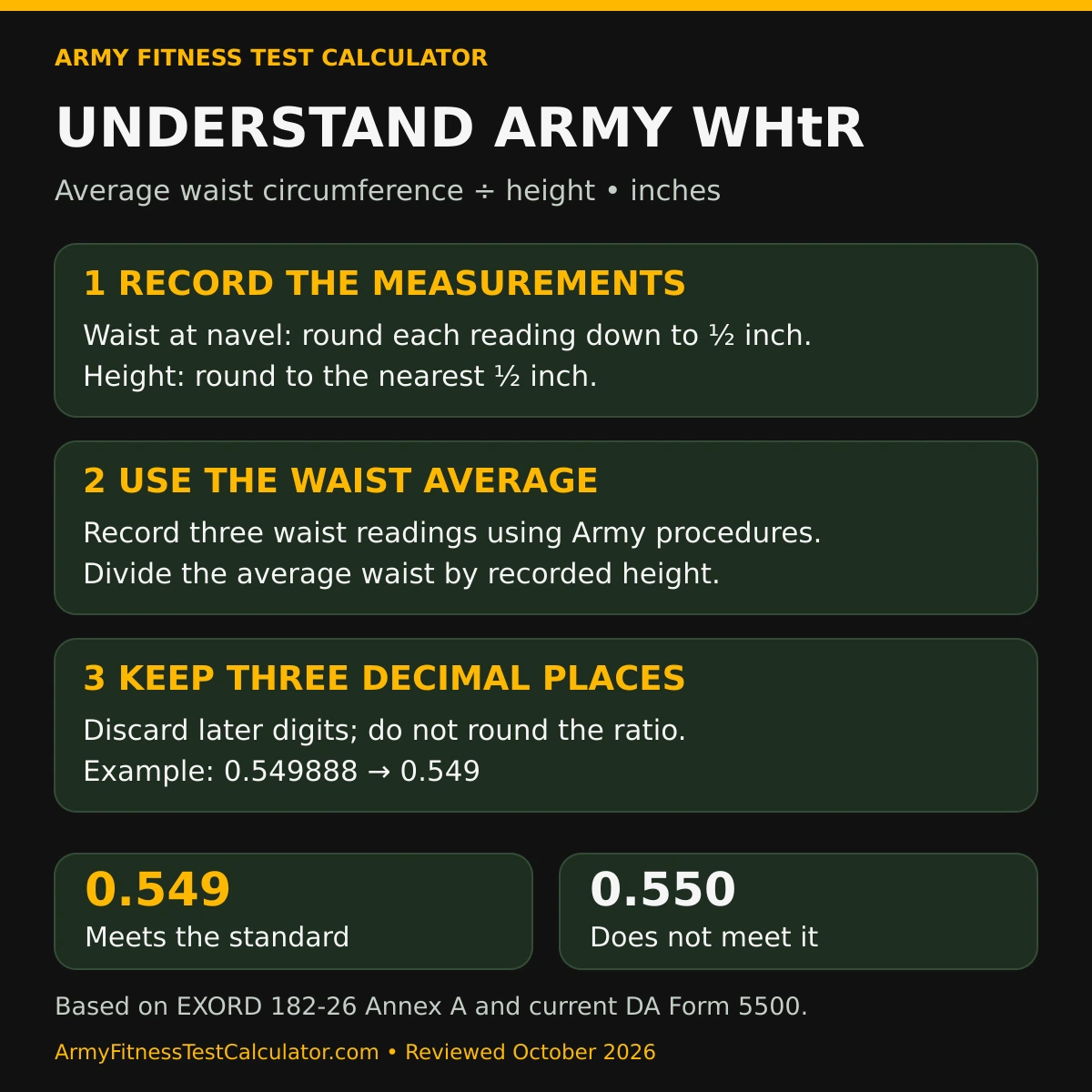
- Waist: measured at the navel with the tape horizontal, touching your body without compressing the tissue; each reading is rounded down to the nearest half inch.
- Repeated readings: three waist measurements are recorded and averaged. If one differs by more than an inch from the other two, additional measurement is needed under the guidance.
This process gives your team several readings to work with, helping prevent a single badly positioned tape measurement from determining the ratio recorded on your worksheet. Once calculated, the ratio is recorded to three decimal places without rounding. Later digits are discarded. For instance, 0.549888 becomes 0.549 and meets the standard.
Measurement rounding comes first. Ratio recording comes afterward. Using ordinary rounding on the final ratio would turn that 0.549888 example into 0.550, so it’s important to keep the two steps clear when checking your result.
Compare These Worked WHtR Examples
These examples start with recorded measurements in inches. The waist value represents the average your official team establishes through the measurement procedure before calculating your ratio:
| Average waist | Height | Calculated ratio | Recorded ratio | Meets standard? |
|---|---|---|---|---|
| 37.0 in | 68.0 in | 0.544117… | 0.544 | Yes |
| 37.5 in | 68.0 in | 0.551470… | 0.551 | No |
| 40.0 in | 73.0 in | 0.547945… | 0.547 | Yes |
For example, the first two rows show how a half-inch difference in average waist changes your outcome at the same height. That makes tape placement and recorded measurements particularly useful details to compare when your home estimate differs from the official assessment.
What Happens if Your Result Is 0.550 or Higher?
Under the Army’s current body-composition policy summary, an initial result outside the standard requires a confirmation assessment by a different team on the same duty day. If your confirmation result is also outside the standard, enrollment in the Army Body Composition Program and a flag follow.
There is an October 2026 qualification: the Army is conducting an initial 180-day policy assessment, during which separation actions for failing WHtR will not occur. Screening, confirmation assessments, flags and program enrollment still apply. Your requirement to meet the standard remains in place.

Get a Useful Estimate Before Screening
A useful estimate starts with a non-stretchable fiberglass tape whose markings you’ve checked against a ruler, followed by a level measurement at your navel without a tight pull. A different position can change the reading even when your body stays the same.
Your recorded measurements give you something specific to compare with the official procedure. And your AFT score calculation remains a separate assessment, with fitness event points recorded independently from your WHtR result.
Frequently Asked Questions
Is DA Form 5500 Still Used?
Yes. The July 2026 DA Form 5500 is the current WHtR worksheet for both men and women, replacing the older body-fat version for this assessment.
Does a High AFT Score Exempt You From WHtR Screening?
The current policy rescinds the previous AFT-score exemption, so even a maximum fitness-test score leaves your requirement to meet the body-composition standard in place.
Is My Online Result an Official Army Assessment?
Your online result is an estimate based on the measurements you’ve entered. The trained measurement team, current worksheet and unit process establish the official assessment.