Sprint-Drag-Carry Calculator — AFT SDC Score from Your Completion Time
Enter your total Sprint-Drag-Carry time, age group, and sex to calculate points from the Army scoring scales effective June 1, 2025.
Sprint-Drag-Carry Scoring Table
| Age | Men 60 | Men ≥70 | Men 100 | Women 60 | Women ≥70 | Women 100 |
|---|
The table is generated from the Army’s official AFT scoring scales. The ≥70 times are the first published thresholds worth at least 70 points; Combat passing requires 350 total points and at least 60 in every performed event.
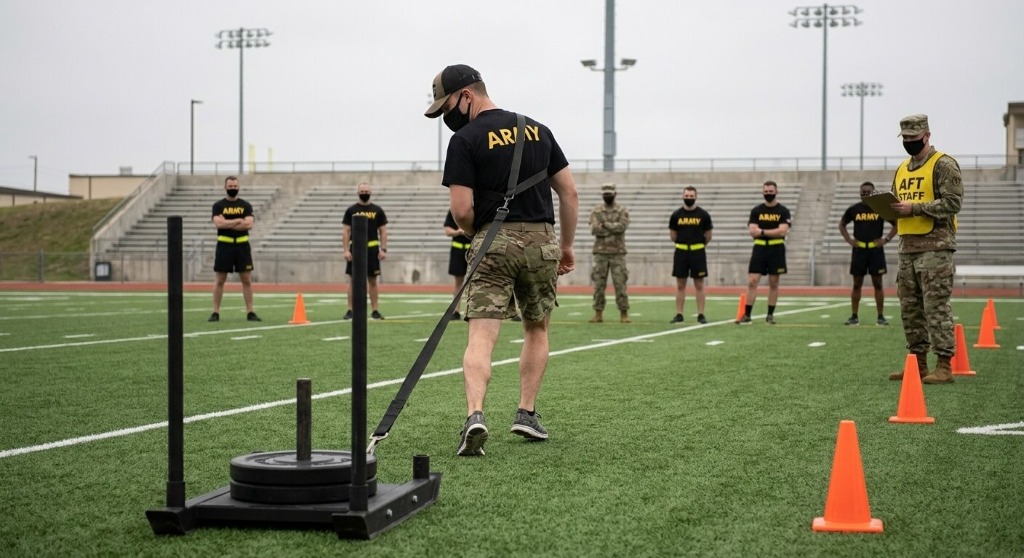
The 90-lb Sled Drag: Mechanics and Acceleration
The 90-pound backward sled drag is the decisive bottleneck of the Sprint-Drag-Carry. Occurring immediately following the opening 50-meter sprint, the sudden transition to heavy backward resistance demands exceptional quadriceps drive, posterior chain recruitment, and core stability.
Under ATP 7-22.01 standards, soldiers must grasp the nylon handles, maintain a low athletic center of gravity, and backpedal powerfully across the 25-meter line until the entire sled crosses before turning.
What the SDC Measures: Five Physical Demands in 250 Meters
The Sprint-Drag-Carry combines five continuous 50-meter shuttles: sprint, backward sled drag, lateral movement, kettlebell carry, and final sprint. It challenges acceleration, change of direction, grip, lower-body power, and the ability to keep moving as fatigue accumulates.
SDC Training Strategy: The Four Limiting Factors
Most Soldiers who struggle with the SDC are limited by one of four factors. First, sled-drag strength — the 90-lb sled on hard flooring or turf requires significant posterior chain power; heavy deadlifts, Romanian deadlifts, and cable pull-throughs directly address this. Second, grip endurance — the dual kettlebell carry (2 x 40 lbs) becomes grip-limited within 10–15 m for most untrained Soldiers; farmer's carries three times per week is the most direct intervention. Third, lateral agility — many Soldiers shuffle too slowly due to insufficient hip abductor strength; lateral band walks and skater jumps build the required movement pattern. Fourth, aerobic base — without a strong aerobic engine, the compounding anaerobic debt of five consecutive lanes becomes overwhelming; regular 400–800 m interval work addresses this.
SDC Scoring Mechanics: How Time Maps to Points
The SDC is recorded as a completion time and converted through the Soldier’s age- and sex-specific scoring row. The curve is not safely approximated as one point per second, so use the calculator for every time. Combat-standard Soldiers may balance event scores as long as each performed event is at least 60 and the five-event total reaches 350. The AFT Passing Standards page explains that rule.
Sprint-Drag-Carry — Frequently Asked Questions
What is the maximum time allowed on the SDC to pass the AFT?
For ages 17–21, 60 points requires 2:28 or faster for men and 3:15 or faster for women. Use the calculator for another age group.
What does the Sprint-Drag-Carry consist of?
The SDC consists of five 50-meter shuttle lanes completed consecutively: (1) sprint, (2) backward sled drag (90 lbs), (3) lateral shuffle left, (4) two-kettlebell carry (2 x 40 lbs), (5) sprint. The total course is 250 meters. The clock runs from start to finish without pauses, and the score is based on the total elapsed time rounded to the nearest second.
How do I improve my SDC time?
Focus on the four limiting factors: (1) sled drag strength — include heavy Romanian deadlifts and cable pull-throughs; (2) grip endurance — perform farmer's carries 2–3 times per week; (3) lateral agility — add lateral band walks and skater drills; (4) anaerobic conditioning — run 400–800 m intervals to build the engine that sustains speed across all five lanes. Practice the full SDC circuit once weekly to cement pacing strategy.
Does surface type affect my SDC score?
Yes. Surface friction, weather, and footing can alter the sled drag and lateral shuttles. Compare practice times cautiously when they were recorded on different surfaces, and follow the test team’s official lane setup for a record attempt.