A familiar benchmark.
A clearer result.
Fitness calculators for Army veterans can help you compare five event performances with current Army tables, check the Army waist standard or revisit a historical APFT score.
If you've separated, you can use whichever comparison is useful to you. These optional benchmarks don't determine your health, VA benefits or eligibility to return to service.
Separated from service? These are optional personal comparisons, not ongoing service requirements.
Know the limits. Independent tool. Not an official test, medical assessment, VA benefits tool, or reentry decision. U.S. Army standards only.
Compare performances with current U.S. Army tables
Use properly measured performances from the standard events. General scoring uses sex and age. Combat scoring is sex-neutral and age-normed. Your unit determines which applies if you are serving. A number entered here is a calculation, not proof that a record test was completed.
Medical restrictions or a permanent profile? Use the profile calculator and your unit’s guidance. This tool requires all five standard events. Do not attempt restricted events.
Scoring source: U.S. Army AFT Scoring Scales, effective June 1, 2025. General and Combat are calculated separately.
Check the Army waist-to-height standard
Compare measurements with the Army threshold of below 0.550. This is not a body-fat percentage or a general health diagnosis. Separated veterans do not have to meet this Army standard.
Sources: Army Directive 2026-13, DA Form 5500, July 2026, and EXORD 182-26 Annex A. Read the full Army body-composition guide for more context.
Give an old score its proper context
An old APFT or ACFT result is a record of a past performance. It cannot establish your fitness today or your eligibility to rejoin.
Recreate a historical APFT score
Use standard push-ups, sit-ups and a 2-mile run. Enter the age group from the original test. These are not hand-release push-ups. This tool covers the standard three-event APFT, not modified tests.
Have the raw performances from an old ACFT?
You can score its deadlift, hand-release push-ups, sprint-drag-carry, plank and 2-mile run on current AFT tables. The standing power throw has no AFT event. If your old ACFT used a leg tuck, do not substitute that number for a plank time.
No old results are copied automatically. The AFT tab will clearly label historical input. For more context, see the legacy ACFT comparison guide and the historical APFT explanation below.
Independent resource by Army Fitness Test Calculator. Not affiliated with or endorsed by the U.S. Army, Department of Defense, or Department of Veterans Affairs.
Reviewed October 23, 2026 against the U.S. Army and VA sources linked on this page. Army policy can change. Serving readers should confirm current instructions with their unit.
Who are fitness calculators for Army veterans designed for?
The most useful calculator depends on whether you've left the Army, are still serving in the Guard or Reserve, or are considering a return to service.
The table below explains how you can use each tool.
| Your situation | What you can use here | What needs another decision |
|---|---|---|
| Separated Army veteran | An optional AFT comparison, an Army waist comparison, or a historical score | Your own activity goals and any medical advice you need |
| Veteran still serving in the Guard or Reserve | A calculation using current Army tables | Your unit confirms the applicable standard, record-test arrangements and profile rules |
| Prior-service applicant | An introduction to the tests and measurements you may discuss with a recruiter | Your recruiter confirms the entry route, medical qualification and any waiver process |
If you are still serving in a combat specialty, your fitness requirements also include a separate Combat Field Test under Army Directive 2026-07, which establishes that test and changes testing arrangements. This hub covers the five-event AFT comparison.
If you are thinking about rejoining, take your questions to a recruiter rather than treating a passing comparison as approval. GoArmy's joining guidance covers requirements beyond exercise performance.
These tools use U.S. Army standards only, so a different resource is needed for another U.S. military service or a foreign military.
Rehabilitation plans, disability ratings and medical exercise clearance are outside this page's scope.

What does your AFT benchmark mean?
Your AFT comparison checks both the score for each event and your overall total.
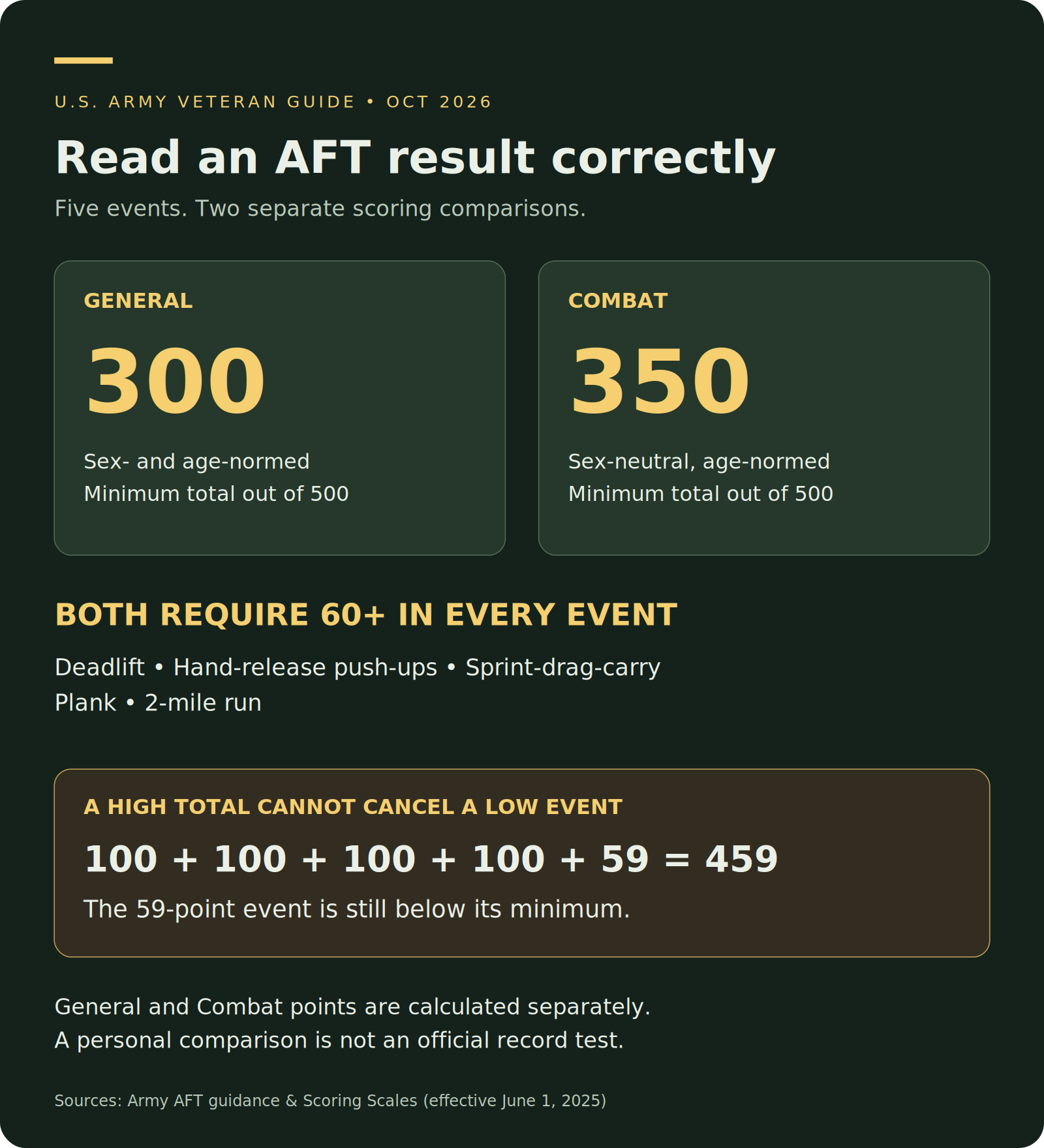
Under the Army's AFT guidance, the minimum is at least 60 points in every event and 300 overall for General, or 60 in every event and 350 overall for Combat.
| Comparison | Event minimum | Total minimum | Scoring basis |
|---|---|---|---|
| General | 60 in all five events | 300 out of 500 | Sex and age |
| Combat | 60 in all five events | 350 out of 500 | Sex-neutral, age-normed |
The calculator looks up your performances in the published scoring scales linked in the AFT tab, with General and Combat results calculated separately.
Because the scoring columns can differ, you can't take a General score and simply compare it with the Combat total of 350.
For example, if you score 60 in each of the five General events, your total is 300 and the numerical requirements are met.
However, if your event scores are 100, 100, 100, 100 and 59, the total would be 459 while still falling below the minimum in one event.
For Combat, the minimum remains 60 in each event, even though the total needs more points somewhere to reach 350.
So if your Combat event scores are 90, 70, 70, 60 and 60, the total would be 350 and meet both checks. These examples explain the arithmetic, rather than prescribe how you should train.
The comparison is more meaningful when your performances follow the relevant event instructions. A shortened run or a different push-up technique changes what you're comparing, even if the calculator accepts the number.
How does the Army waist check work?
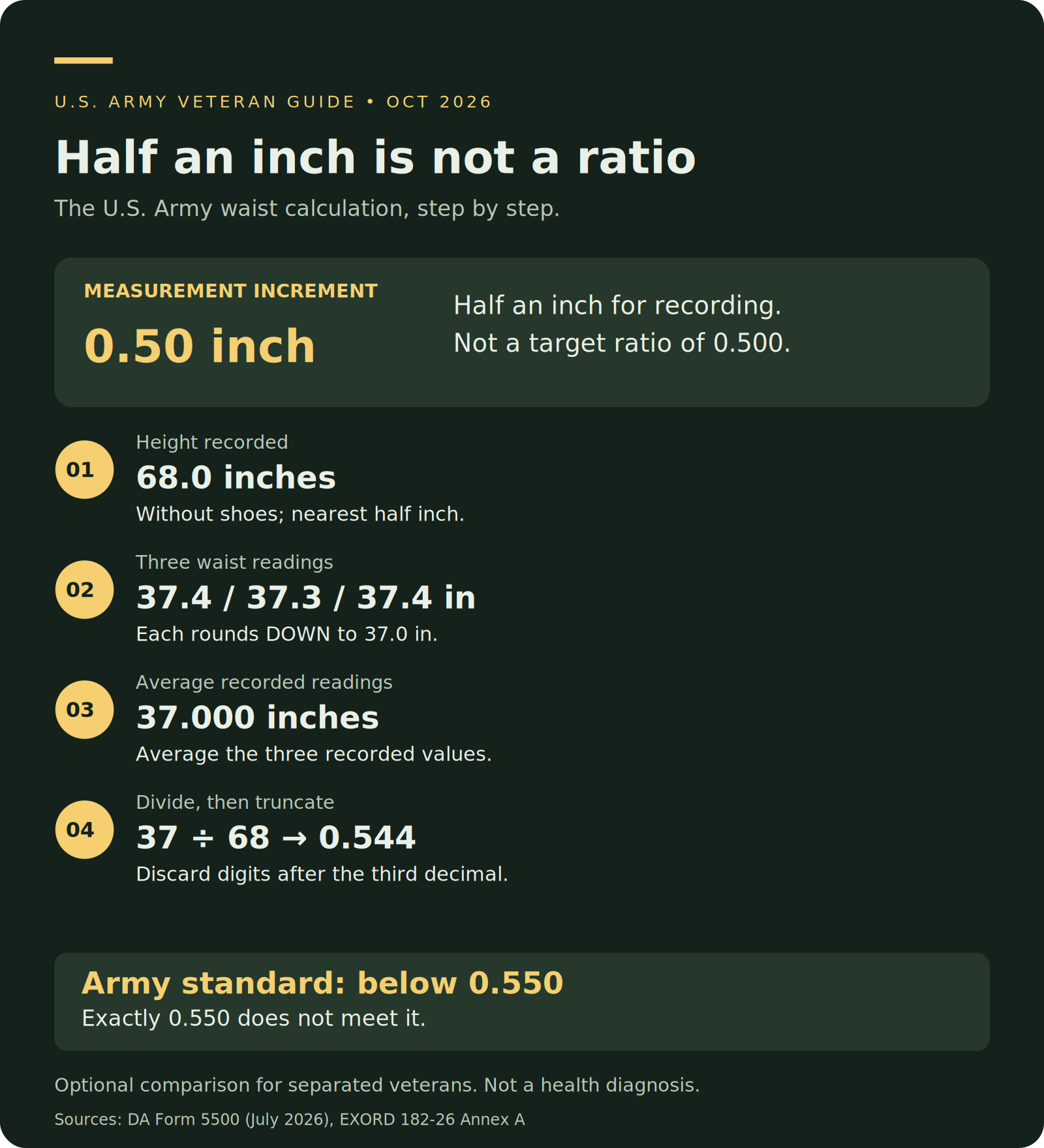
The 0.50-inch rule comes from U.S. Army resources and tells you how to record measurements. Simply put, half an inch is the recording increment.
Your waist-to-height ratio is a separate calculation, for which the Army standard is below 0.550. Exactly 0.550 doesn't meet that standard; this calculator sets no additional 0.500 target.
The July 2026 DA Form 5500 and its measurement instructions are linked in the waist tab. For three consistent readings, the calculation follows this order:
- Record height without shoes to the nearest half inch.
- Measure the waist at the navel with a level, non-stretch tape, without compressing the skin. Round each reading down to the nearest half inch.
- Average those recorded waist readings to three decimal places.
- Divide the recorded average waist by the recorded height. Truncate the ratio to three decimal places; do not round it up.
For example, suppose your height is recorded as 68 inches and your three waist readings are 37.4, 37.3 and 37.4 inches.
After rounding each waist reading down to the nearest half inch, the result is three entries of 37.0 and an average of 37.000.
Dividing 37 by 68 gives 0.544117… . You'd record 0.544 after discarding the later digits, which puts this example below the Army threshold.
If your rounded readings differ by more than one inch, the Army instructions require an additional-measurement procedure, so the calculator requests that you resolve the measurements rather than giving a verdict.
Your unit's trained team can follow that procedure. You can then use its confirmed form average in the calculator where appropriate.
Army Directive 2026-13 also removes an AFT-score exemption from this waist standard and requires same-duty-day confirmation by a different team after an initial result that does not meet it, before command action. The Army's September 18, 2026 update continued to identify that directive as the governing policy.
For separated veterans, this result is an Army comparison rather than a body-fat estimate or medical assessment. A suitable personal waist goal is a separate health question.
How should you read an old APFT or ACFT score?
An old score is useful when you keep the test date, your age at that test, the event performances and the scoring system with it.
You might remember every repetition of a personal best from ten years ago, but it's still a record of what you did then.
In the historical APFT tab, you use your original age group with standard push-ups, sit-ups and the 2-mile run. Hand-release push-ups belong to a different event.
The site's historical APFT guide provides more background on those older tables.
If you've kept an old ACFT scorecard, the calculation needs five relevant raw performances to calculate an AFT comparison: deadlift, hand-release push-ups, sprint-drag-carry, plank and 2-mile run.
The AFT excludes the standing power throw. If your old test used a leg tuck, you need a separate plank performance rather than a repetition count.
When you select “Historical performances, current tables,” your result carries a historical label so you can distinguish it from a comparison using today's performances.
Subtracting the power-throw points from an ACFT total isn't an AFT conversion, because each remaining performance still needs to be scored on the AFT tables.
Staying active after service
You may be more interested in walking comfortably, keeping up with family or building a routine you can maintain than reaching an Army test score.
That's a useful starting point. Your own goals can help you decide whether an Army benchmark is a comparison you'd like to follow.
The VA's physical activity guidance, updated in March 2026, recommends at least 150 minutes of moderate-intensity or 75 minutes of vigorous-intensity aerobic activity each week, or an equivalent combination, plus muscle-strengthening activity at least twice weekly. Those are general adult recommendations. Your starting amount can depend on your circumstances.
For example, five 30-minute periods of moderate activity would add up to 150 minutes over a week, but those minutes can also be spread across shorter periods.
That's an example of organizing the total, rather than a starting schedule for everyone.
VA advises choosing activities you enjoy, starting at a comfortable level and increasing time or frequency as activity becomes easier. Every minute counts.
You can generally talk during moderate activity, while vigorous activity leaves you able to say only a few words before taking a breath.
If you have concerns about a health condition, your health care team can help you choose a suitable plan.

There are also options beyond preparing for a test:
| Official resource | Where it may help | What to check |
|---|---|---|
| VA Gerofit | Older veterans looking for guided strength, aerobic and balance activities | VHA enrollment and sufficiently stable health are required. Ask your provider about joining; video participation may be available. |
| VA Adaptive Sports and Arts | Veterans exploring adapted recreation and rehabilitation events, including wheelchair and winter sports | Check the specific program's eligibility and application information. The hub is a starting point, not an enrollment approval. |
| MOVE! at VA Puget Sound | A concrete example of VA support covering nutrition, activity and behavior change | This regional program lists group, individual and remote support. Ask your own VA facility about local eligibility and available formats. |
You can explore these resources whether or not you choose to attempt an AFT comparison. Your disability rating alone doesn't establish which events are suitable for you.
If an event conflicts with a restriction, your activity plan should respect that restriction, with appropriate guidance for your circumstances.
Add a free calculator to your veteran resource page
If your readers are U.S. Army veterans, you can link to this hub or place one of the two calculators on your own resource page. The AFT benchmark is useful for comparing standard event performances. The waist calculator explains a specific Army measurement rule; it should not be introduced as a body-fat or general health assessment.
Once you've chosen a calculator below, you can copy the complete embed code into a Custom HTML block on your own website.
“Preview calculator” opens the actual page loaded by the iframe. The complete code includes the iframe and resizing support. One small credit appears inside the calculator.
The main calculator embed directory also provides both veteran tools alongside the existing AFT calculators. You can use either embed without signing up or adding a separate link to our website. A resource-page recommendation is welcome if you find the tools useful, but it is entirely optional.
Prefer a link? Fitness Calculators for Army Veterans. Add the tool that fits your readers. Inclusion does not imply Army or VA endorsement.
Each calculator has one small credit inside its iframe, with no separate credit beneath it. The widget fits its container up to 900 pixels wide and resizes with results. Backup heights and scrolling remain available if the resizing script is blocked. Embeds contain no ads, navigation or calculator analytics.
Frequently Asked Questions
These details can help when you are saving a comparison or deciding which tool to use.
Where are my saved results stored?
Your AFT and historical APFT results stay in this browser when you choose Save, rather than being submitted to the Army or VA.
Clearing browser data or switching devices affects access to those entries. Waist results offer printing only, with height and waist measurements excluded from saving, and embeds have no Save option.
For instance, if you calculate a result on a shared computer, anyone using the same browser may be able to open a saved entry.
How often should I repeat a test?
If you're separated, you can choose whether to repeat a personal comparison; this hub sets no schedule.
For serving veterans, your unit confirms record-test scheduling based on duty status, combat-specialty requirements and the AFT/CFT arrangements. Your personal comparisons remain separate from required record tests.
Is the waist chart an exact amount I need to lose?
The chart gives you the largest half-inch waist entry below the Army threshold at your recorded height, rather than an exact required reduction.
Because an average of three readings can fall between half inches, your confirmed average may differ from a chart entry. Treat the chart as an Army reference, not a medical weight-loss recommendation.
Can I use this AFT benchmark with alternate or waived events?
This benchmark covers all five standard events, so the profile calculator and your unit's instructions are the more relevant starting points for modified Army tests.
Any restrictions still apply, and a civilian restriction doesn't automatically establish an Army-approved permanent profile. Leave restricted events out rather than trying them to fill a field.