DA Form 705-CFT is the Combat Field Test scorecard. It records seven event completions, grader initials and one total time, with a GO or NOGO decision. Use this guide to identify the current edition, put each entry in the correct column and review the completed record before signing.
How to complete DA Form 705-CFT
You can begin with the Soldier's identifying information, then use one test column for the attempt. Record its date, AOC or MOS, pay grade and age. Graders initial their event lines, and the completed test needs the Soldier's signature, the OIC or NCOIC entries, the total time and the final decision.
The official DA Form 705-CFT PDF has two pages and room for four tests. Its layout differs from the older six-event ACFT scorecard and the current five-event AFT points form.
You can use the checklist below to review a record with your test staff. The official entries and decision come from authorized personnel administering the test.
Check the edition and choose the right test column
The current form is dated April 2026. The Army Publishing Directorate record lists it as active and shows change 101 dated September 1, 2026. These details were rechecked on November 2, 2026.
You can obtain the current scorecard from that official record. The footer date identifies the edition; your actual test date belongs in the separate YYYYMMDD field.
Page one contains Test One and Test Two. Page two contains Test Three and Test Four. Each page repeats name, unit or location and sex above its columns, so you can check the identity on the page you're using even when pages have been scanned separately.
Your attempt belongs in one column. For instance, Test Three's date, initials, total time and signatures should all remain in Test Three, rather than the time appearing beside Test Four. That makes the record easier for you and the unit reviewer to follow.
Record the seven events and one overall time
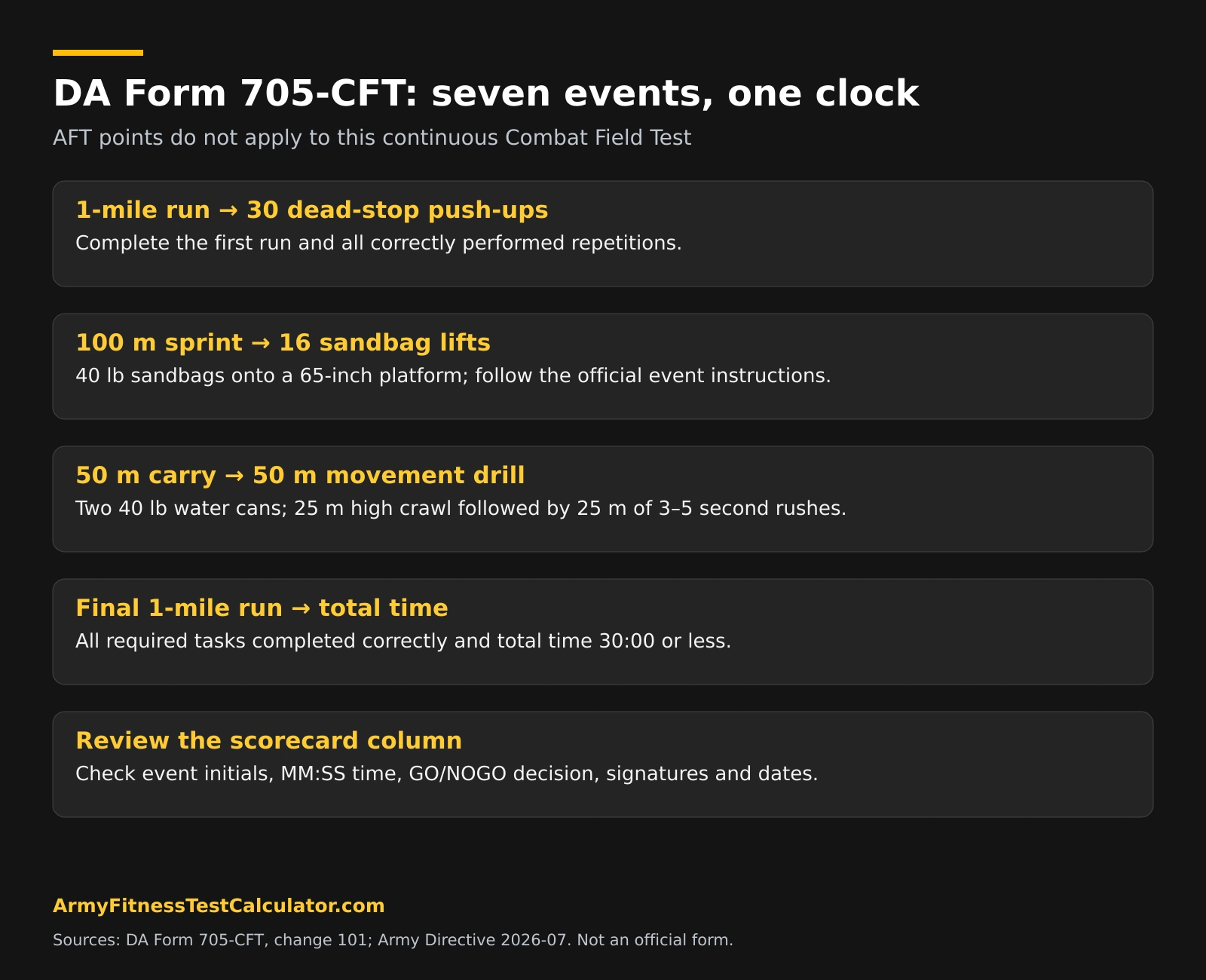
The CFT is one continuous sequence with a cumulative completion time. Graders initial the event lines, while the final result records the overall time and GO or NOGO decision.
| Order | Event shown on the form | Detail to check |
|---|---|---|
| 1 | One-mile run | The opening run is separate from the final run. |
| 2 | Dead-stop push-ups | 30 correctly performed repetitions. |
| 3 | Sprint | 100 meters. |
| 4 | Sandbag lifts | 16 lifts of a 40-pound sandbag onto a 65-inch platform. |
| 5 | Carry | 50 meters with two five-gallon Army water cans weighing 40 pounds each. |
| 6 | Movement drill | 50 meters total: 25 meters of high crawl and 25 meters of 3–5 second rushes. |
| 7 | One-mile run | The closing run completes the sequence. |
The time field uses MM:SS and states 30 minutes or less. The printed example is 28 minutes, 32 seconds, written as 28:32. A decimal such as 28.32 would be less clear in a field that specifically asks for minutes and seconds.
Army Directive 2026-07 explains that individual events aren't timed separately and that the CFT has no points. Correct completion of the required tasks still matters alongside the time standard. Graders and the OIC or NCOIC must resolve questions about an event under the applicable instructions.
Review a completed example before signing
Suppose you correctly complete all seven tasks in 28:32. That time meets the printed 30-minute limit. Your scorecard still needs the event initials and the authorized GO decision to document the administered attempt.
You can work down the column in this order:
- Check that the date, AOC or MOS, pay grade and age describe this test.
- Confirm that each event has its grader's initials.
- Read the total time in this test's own MM:SS field.
- Check the OIC or NCOIC name and pay grade, and the selected GO or NOGO result.
- Review the Soldier and OIC or NCOIC signature and date fields.
If your time were 30:01, it would exceed the limit by one second. Copying it as 30:00 would change the recorded result. An omitted event also can't be represented as completed simply because a total time has been entered.
You can raise a missing initial or disputed entry while the test staff reviews your attempt. The Soldier's signature field and the OIC or NCOIC signature field serve different people; one signature doesn't fill both roles. After review, retain a copy through the unit's normal records process.
Keep CFT results separate from AFT points
Your CFT record shows whether you completed that continuous test to standard. An AFT record contains five scored events with a maximum of 500 points. Keep both records identified when reviewing a packet or training history.
The note at the top of the CFT form summarizes annual testing, but the directive contains component-specific schedules and implementation provisions. For example, Regular Army, AGR and Reserve Component Soldiers on active-duty orders for 365 days or more have a different schedule from other Reserve Component combat-specialty Soldiers. The combat field test guide explains that context.
The one-year implementation period also matters when discussing consequences. During that period, the directive protects Soldiers from administrative action based solely on CFT failure or a profile preventing the CFT. A diagnostic result doesn't replace the separate record AFT requirement.
For the five-event scorecard, the DA Form 705-AFT guide explains the current fields. You can identify the correct record by checking the test name printed on the form.
Frequently Asked Questions
Does DA Form 705-CFT award promotion points?
The CFT itself is pass or fail and has no points. Its cumulative time isn't a 500-point AFT score or a historical 600-point ACFT score. A promotion calculation uses the applicable separate fitness and promotion rules.
Can all four tests be entered on page one?
The first page has Test One and Test Two. Test Three and Test Four are on page two. Use each printed column so its date, event entries, result and signatures stay together.
Can a calculator result replace my signed scorecard?
Your official scorecard documents an administered test with grader initials, the OIC or NCOIC decision and the required signatures. You can obtain that completed record through your unit. A typed time alone doesn't supply those entries.
Can a profile replace one of the CFT events?
The directive doesn't authorize modified CFT events for profiles. Its specific provisions address temporary restrictions and permanent-profile eligibility. Your unit and profiling provider should apply those provisions to your current record.