Reviewed September 2026 · Official Army 2026 guidance
Army Combat Field Test (CFT) 2026
The Combat Field Test is a separate, seven-event requirement for designated Army combat specialties. Enter your total continuous time below to check it against the Army’s 30:00-or-less standard. The CFT is pass/fail, not a 500- or 600-point test.
2026 transition: The one-year implementation period is diagnostic. This independent practice checker does not record an official result; your grader and unit determine an official outcome.
Check a CFT time ↓Army CFT Time Checker
Use the elapsed time from the start of the first mile through the end of the final mile. Confirm each station was completed in order. Individual stations do not earn points and are not separately timed for the official CFT.
Ready to check
Enter the cumulative time and mark the events you completed.
Example: 29:59 with all seven events complete meets the time requirement; 30:00 also meets it, while 30:01 does not. A fast time cannot make up for an event that was not completed. This tool cannot verify movement technique, equipment, profiles or your unit’s course.
What is the Army Combat Field Test?
The Army introduced the CFT in April 2026 as an additional field requirement for certain combat specialties. Army Directive 2026-07 makes two distinctions easy to miss: the CFT does not replace the Army Fitness Test (AFT), and it has no point scale. Soldiers complete seven tasks consecutively. The clock runs across the whole course; the final time and completion of every event determine the result.
That is why an “Army CFT calculator” should not turn a push-up count into points or assign independent scores to a sprint or carry. This page checks the single published time limit and whether you have marked every required event. For the five-event, point-scored test, use the separate AFT calculator.
The seven Combat Field Test events, in order
The Army’s CFT testing annex specifies the station sequence and execution details. Complete a station before your grader clears you to move to the next; a pause, rest or wait between stations still counts toward the cumulative time.
- First 1-mile run. Begin at the starting line on the designated course. Pace yourself knowing the final event is another full mile.
- 30 dead-stop push-ups. At the bottom, the chest touches the ground and both hands leave the surface; the annex does not require a specific “T” or hand-release arm motion. Only correctly completed repetitions count.
- 100-meter sprint. Cover the validated course from start to finish before proceeding.
- 16 sandbag lifts. Lift sixteen individual 40-pound sandbags onto a 65-inch platform; a bag that falls must be replaced before the task is complete.
- 50-meter water-can carry. Move two five-gallon Army water cans, each weighing 40 pounds, to the endpoint. The annex allows setting them down but not dragging or throwing them.
- 50-meter movement drill. High crawl for 25 meters, then perform the 25-meter 3–5-second rush using the prescribed technique.
- Final 1-mile run. Complete another measured mile without physical assistance. Stopping the clock after the carry would omit two required events.
Running at both ends of the course
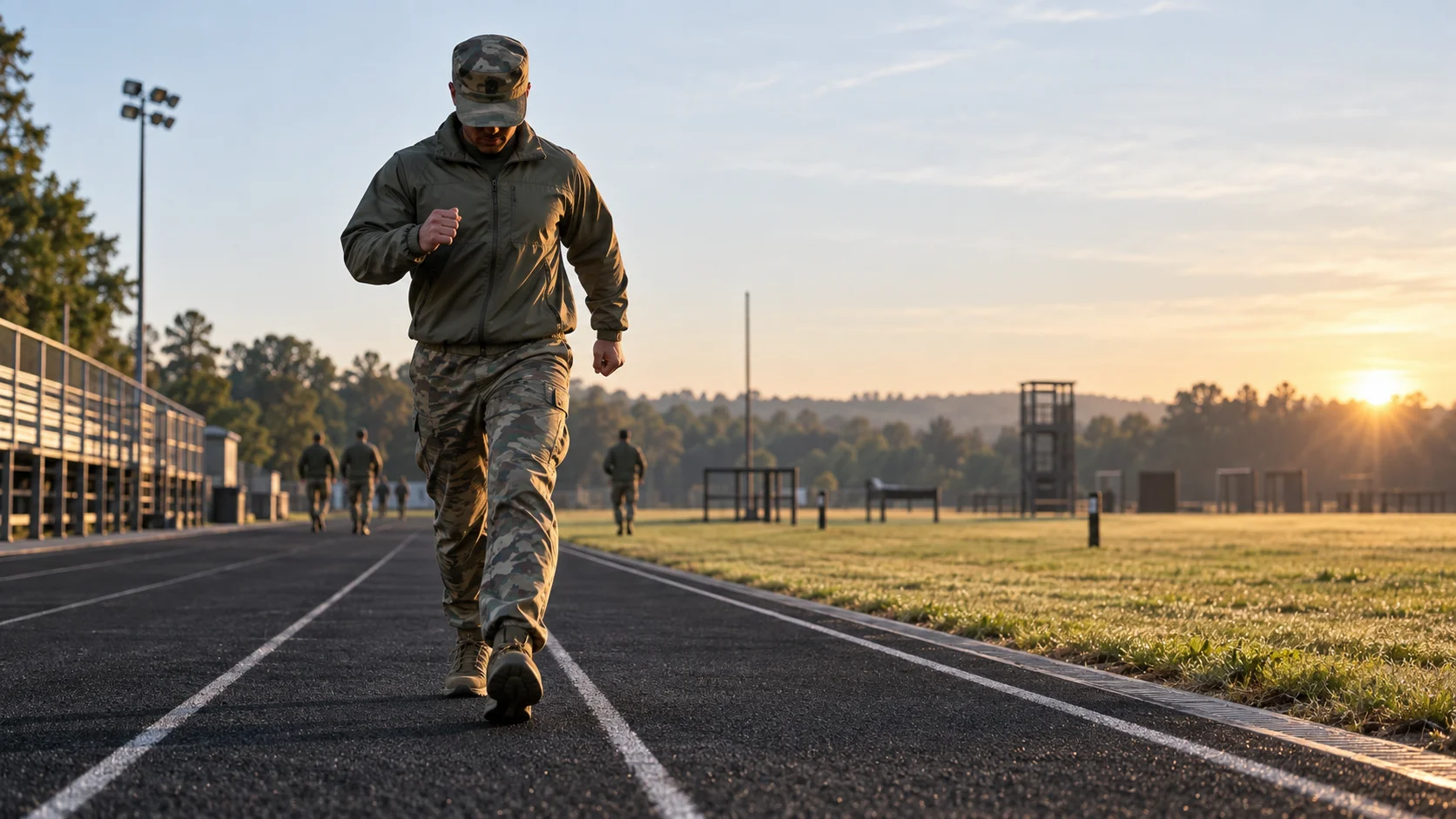
The first and seventh events are each a one-mile run, with the other five tasks between them. Their times are not added as separate scored events; the clock continues through the stations and transitions.
Plan a realistic pace for both miles rather than assuming the first-mile finish represents half the work. The accompanying photograph is an illustration, not an official CFT course diagram.
Dead-stop reps, not AFT event points
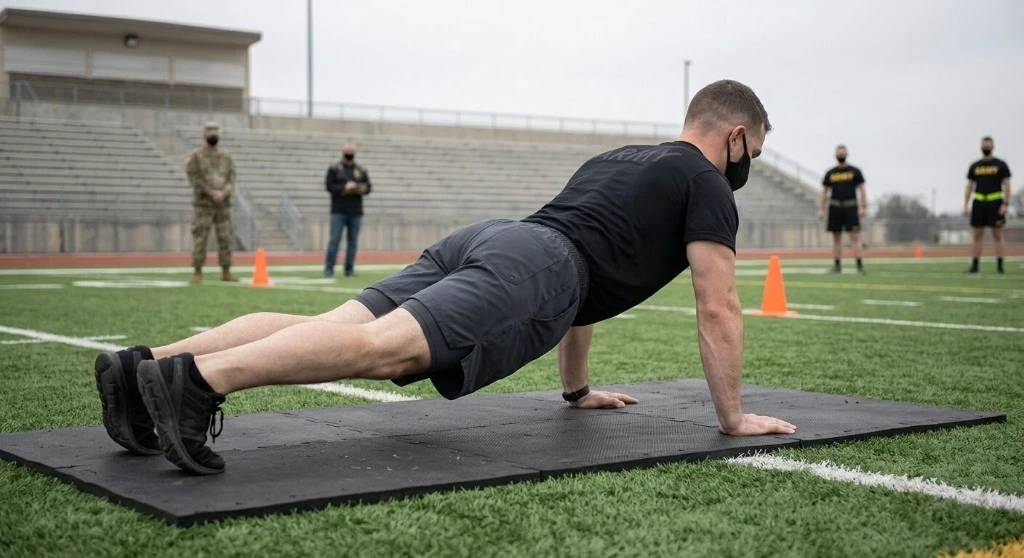
The CFT requires 30 accepted dead-stop push-ups before the Soldier can move on. A rep that does not meet the annex’s movement standard is not counted, even if the time on the clock looks favorable.
The image illustrates a push-up position, not the full prescribed dead-stop technique. Read the Army testing annex for the exact rep standard before practicing.
Army CFT standards: how the 30-minute rule works
The Army’s implementing HQDA execution order sets the overall limit at 30:00 or less. The same standard applies regardless of age or sex. This is not 30 minutes per event: it is the total from the start of the first run to completion of the last run, including movement between stations.
That is the current Combat Field Test time standard, not an “ACFT passing score.” The CFT is a distinct Army field test: you must complete each prescribed station, and even a fast overall time does not replace a missing or invalid event.
| Elapsed time | All seven events complete? | Time-checker result |
|---|---|---|
| 29:59 | Yes | Meets 30:00 limit |
| 30:00 | Yes | Meets 30:00 limit |
| 30:01 | Yes | Over the limit |
| 27:00 | No | Cannot count as complete |
As of September 2026, the directive provides a one-year implementation period during which no administrative action is taken solely because of a failed CFT or a permanent profile that prevents taking it. That transition does not change the prescribed test sequence or time standard. Do not use this checker to replace a grader’s determination.
Who takes the CFT, and how often?
Army Directive 2026-07 identifies 24 combat specialties: 11A, 11B, 11C, 11Z, 12A, 12B, 12D, 13A, 13F, 18A, 180A, 18B, 18C, 18D, 18E, 18F, 18Z, 19A, 19C, 19D, 19K, 19Z, 89D and 89E. The directive also adds 12D, 89D and 89E to the AFT Combat standard; older 21-specialty AFT lists need that update. If your specialty or profile is uncertain, check your unit’s applicable guidance rather than selecting a standard solely from an online list.
During the implementation year, designated Soldiers take a diagnostic CFT. After implementation, Regular Army and specified AGR and long-order Reserve Component Soldiers in those specialties take one CFT and one AFT annually; other Reserve Component Soldiers in those specialties alternate an AFT record test and a CFT record test by calendar year. The directive specifies spacing between record tests and separate profile/waiver rules. See the site’s Combat MOS and AFT score requirements for the AFT side of the comparison.
CFT versus AFT versus legacy ACFT
| Test | Use here | Result format |
|---|---|---|
| CFT (2026) | Seven-event field test for listed combat specialties | Pass/fail; 30:00 total |
| AFT (current) | Five-event Army fitness test, including Combat scoring where applicable | Event points and composite score |
| ACFT (legacy) | Historical six-event test; not today’s CFT | Historical event points and total |
If your goal is to look up a historical deadlift score or standing power throw, use the legacy ACFT standards. An old search for “army combat fitness test calculator” normally refers to that six-event ACFT, not this newer Combat Field Test. The CFT does not add a new point-scored event to your AFT scorecard.
Review the CFT scorecard
DA Form 705-CFT records seven event completions, one cumulative time and a GO or NOGO result, with four test slots across two pages. The CFT scorecard walkthrough explains its edition and fields.
What is a good or average Army CFT time?
The published 30:00 limit is a passing standard. It does not establish an Army-wide average or a record. A complete 20:00 or 25:00 attempt is inside that limit, but a percentile, average completion time or fastest verified result would need actual results from a stated group and testing period. The time checker cannot establish those rankings.
Does the clock stop during CFT push-ups?
No. The cumulative clock continues through the push-ups and any rest. Annex B permits resting in any position, then returning to the starting position before resuming. You need 30 accepted repetitions before moving on. An inability to complete a required station ends the test as a failure; a rest does not create a separately timed push-up event.
When does CFT testing for record begin?
The Army’s published CFT timeline begins diagnostic implementation on April 17, 2026 and record implementation on April 17, 2027. Your unit’s scheduled test window is different from those Army-wide dates. Confirm your component’s calendar with the unit rather than assuming a universal “CFT season” start or finish.
Sources: Official Army source.
Army Combat Field Test FAQs
What is a passing Army CFT time in 2026?
Finish all seven events in sequence in 30 minutes or less. A 30:00 finish meets the published limit; 30:01 does not.
Does the Army CFT have a score chart or points calculator?
No. The 2026 CFT has no numerical point bands. Check your complete seven-event time against 30:00 and confirm that each station was completed. The time checker above makes that comparison; the AFT score chart applies only to the separate five-event test.
For the official Army CFT scorecard, use DA Form 705-CFT. APD lists the April 2026 form with change 101 dated September 1, 2026.
It records total time, GO/NOGO, grader initials and signatures. This page’s time checker is an educational aid, not that official record.
Do I need to run both miles without stopping?
Both miles must be completed on the designated course without physical assistance. The testing annex permits walking, while strongly discouraging it; elapsed time keeps running.
Does the CFT replace the AFT for combat MOS Soldiers?
No. It is an additional requirement for the designated specialties. During the 2026 implementation year, it is diagnostic, with separate rules for subsequent record-test frequency.
Can I use AFT push-up points or SDC time as CFT results?
No. The CFT’s 30 dead-stop push-ups and field stations follow their own execution rules. Neither an AFT event score nor a separately recorded SDC time produces a CFT pass.
Independent educational resource, reviewed September 2026. Army and unit policy, trained graders and official records govern actual assessments.