This OPAT calculator checks the category reached by your four Occupational Physical Assessment Test results. Enter your standing long jump, seated power throw, strength deadlift and completed interval-run shuttles to see the Gold, Gray and Black thresholds. Your overall category depends on meeting the required minimum in every event.
OPAT calculator for your four recorded results
Use the performances recorded by your grader. The two power events use centimeters, the three-repetition deadlift uses pounds and the interval aerobic run uses the number of completed shuttles.
Your result shows the highest category met across all four events and each event's category. Your recruiter can help you compare that result with the requirement for your particular MOS or area of concentration.
If you change a result, calculate again. An empty field needs an entry before the checker can return a category; an entered zero is treated as a performance below the published minimum.
OPAT categories and minimum event results
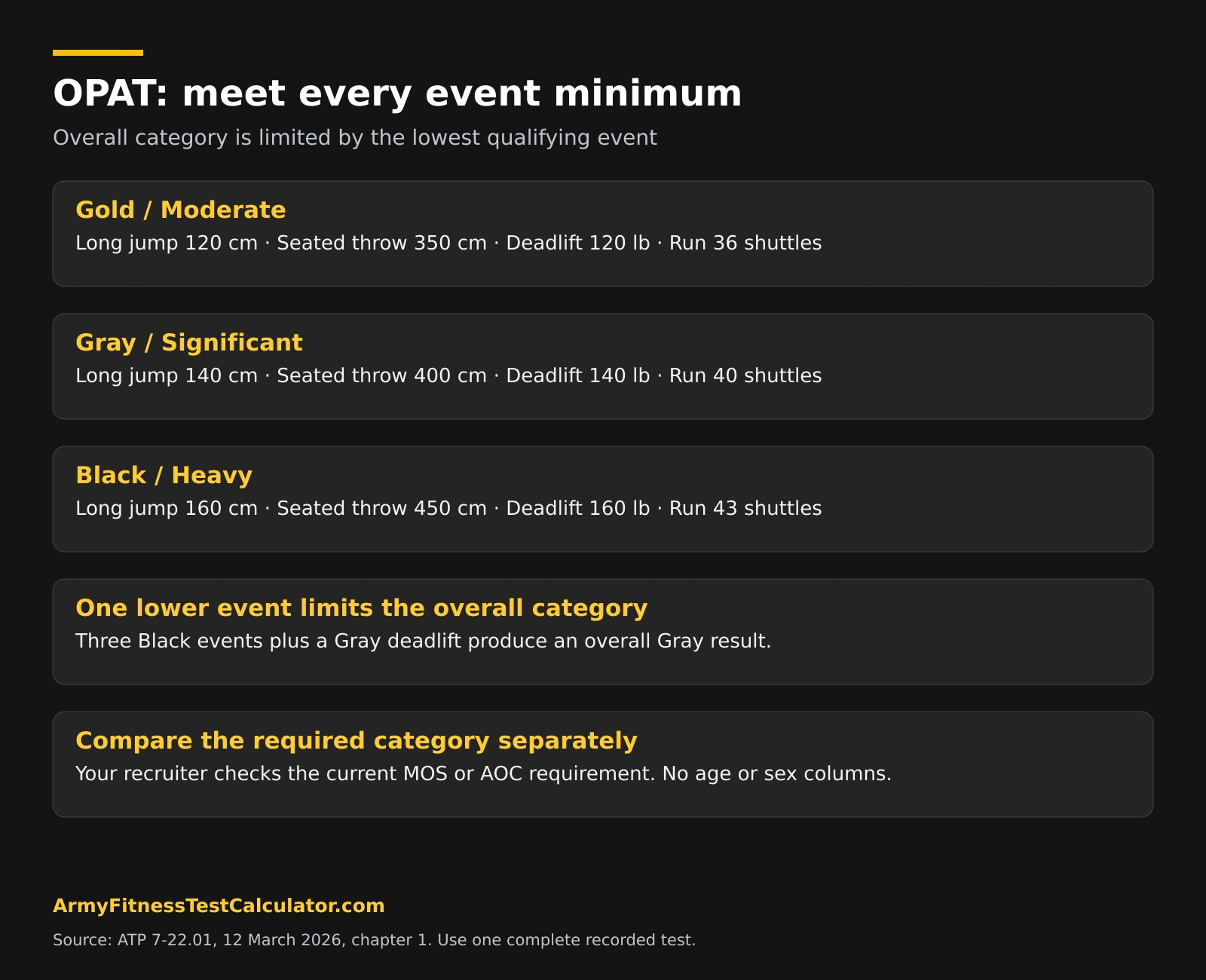
Gold corresponds to Moderate physical demand, Gray to Significant and Black to Heavy. You need every minimum in the category row, rather than a combined points total.
| Category | Standing long jump | Seated power throw | Strength deadlift | Interval aerobic run |
|---|---|---|---|---|
| Gold / Moderate | 120 cm | 350 cm | 120 lb | 36 shuttles, level 5-4 |
| Gray / Significant | 140 cm | 400 cm | 140 lb | 40 shuttles, level 5-8 |
| Black / Heavy | 160 cm | 450 cm | 160 lb | 43 shuttles, level 6-2 |
The thresholds come from ATP 7-22.01, dated March 12, 2026, paragraph 1-23 and Tables 1-2 through 1-5. These category values aren't divided into age or sex scoring columns.
A result below a Gold minimum in any event leaves the overall result below Gold. Your stronger events still appear in the breakdown, which helps you see the particular threshold that remains unmet.
Enter each recorded result in the correct unit
Two entries describe distance, one describes a load and one describes completed shuttles. Those units matter when you copy a correct performance into the checker.
Standing long jump: centimeters
Enter your recorded jump distance in centimeters. For instance, 1.60 meters is 160 centimeters, so you would enter 160. The standing long jump is OPAT's lower-body power event.
Your grader's valid recorded attempt is the useful number here because it accounts for the landing, measurement and any required repeat under the test rules.
Seated power throw: centimeters
Your seated throw distance also uses centimeters. A 4.50-meter result becomes 450 centimeters.
This is a seated power throw. The retired ACFT standing power throw used a different event and score table, so an old standing-throw result belongs with that historical record rather than in this field.
Strength deadlift: pounds
Enter the load recorded for the three-repetition OPAT strength deadlift. For example, if you completed the required repetitions with 140 pounds, your entry is 140 because the scorecard records the load used for the attempt.
That load is compared with OPAT's category thresholds. It isn't multiplied by the repetition count or converted into age-based AFT points.
Interval aerobic run: completed shuttles
Use the number of completed shuttles on the tracking record. For example, level 6-2 corresponds to 43 shuttles, so you enter 43 rather than the decimal 6.2.
The event uses 20-meter shuttles paced by the prescribed audio. A separate continuous run of the same total distance wouldn't reproduce its pacing and event rules.
See why all four events must meet the category
Your overall category is limited by the event reaching the lowest category. Suppose you have a 160-centimeter jump, a 450-centimeter seated throw, a 140-pound deadlift and 43 completed run shuttles.
The jump, throw and run meet Black thresholds. Your deadlift reaches Gray and remains below Black's 160 pounds, so the overall result is Gray / Significant.
You can use the breakdown when discussing training or another attempt with your recruiter. In this example, you'd be discussing the deadlift threshold and an appropriate way to work toward it, rather than trying to make extra jump distance compensate for that event.
Compare the result with your Army specialty requirement
The category required for the MOS or area of concentration you're pursuing is a separate question. The test manual requires the applicable physical demand category before shipping to initial training. A Gold result can therefore be calculated correctly while still falling short of a specialty requiring Gray or Black.
Your recruiter can check the current requirement for your intended specialty and circumstances. This checker only calculates the category reached by the entered performances; it doesn't maintain an occupational-eligibility database.
The current five-event AFT is another assessment. If you need to score those performances, the AFT calculator uses the current event tables.
Review your scorecard before another attempt
OPAT is recorded on DA Form 7888, including the interval-run tracking information. The event names and units on that record are the starting point for checking an unexpected category.
For instance, a throw entered as 4.5 centimeters instead of 450 centimeters would explain a large difference immediately. Once your entries agree with the scorecard, you can compare the relevant category row with the grader or recruiter.
ATP 7-22.01 describes results as valid for up to 90 days and allows retesting after an appropriate training interval. Your next test date should follow the applicable recruiting guidance and your circumstances.
Frequently Asked Questions
Can I combine my best events from different test days?
That would not represent a completed OPAT under the manual. The four events must take place on the same day within a one-hour test period. Use one complete test's recorded results when checking its category.
Does the OPAT calculator need my age or sex?
No. The published category thresholds used here don't have separate age or sex scoring columns. The four event results establish the calculated category; the required occupational category is checked separately.
Can I enter practice results?
Yes, you can compare practice numbers with the published thresholds. Keep them identified as practice, because a category from those numbers isn't an administered test or an official Army record.