Use this historical ACFT calculator to check a six-event score under the March 23, 2022 tables. Enter your recorded performances, age group and scoring column to see each event's points, the total out of 600 and the individual event checks. Current five-event AFT results use a different test.
Historical ACFT calculator for six recorded events
Enter all six performances from the same historical scorecard. Your deadlift entry is the weight successfully lifted for three repetitions, while the standing power throw uses meters and the push-up field uses correctly completed repetitions.
Each timed event has separate minutes and seconds fields. Include a zero where needed, such as 22 minutes and 0 seconds for a 22:00 run.
Your result includes each event's points and whether it reaches 60. The total appears after you've supplied a complete set of valid entries. Changing a field clears the old result so you can calculate again with the updated information.
This tool covers a complete six-event scorecard. Your unit remains responsible for the administered test and any personnel use of an older record.
How the six-event ACFT score is calculated
Each event contributes up to 100 points, giving a maximum total of 600. Under the ordinary six-event standard, every event must reach 60 points. Six 60-point performances total 360.
The calculator reads the Army's archived ACFT scoring scales dated March 23, 2022. It selects the highest published points threshold that your recorded performance meets. Larger results are better for the deadlift, throw, push-ups and plank; shorter times are better for the sprint-drag-carry and two-mile run.
Some source cells contain a dash. Those cells don't publish a raw-performance threshold for that points value, so the calculator retains the gaps instead of interpolating a new weight, repetition count or time. A small improvement may leave your points unchanged until you reach the next printed threshold.
The archived plank table's second page has a row labeled 50 on the left and 60 on the right. This calculator follows the left-hand 50 label and the surrounding 51, 50, 49 sequence. All twenty values in that row were also checked against the clearly labeled official AFT 50-point row. Other current-test tables weren't substituted for the historical data.

Choose the correct historical scoring column
Use your age group on the date of the old test and the scoring column on its record. Your current age may put you in a different group, even though the performance you're checking hasn't changed.
For instance, the March 2022 deadlift table gives a male Soldier aged 17 to 21 a 60-point threshold at 140 pounds. For a female Soldier aged 22 to 26, that threshold is 120 pounds. You need the appropriate column to reproduce either score.
Your test date also helps identify the scoring edition. Earlier ACFT versions used different rules and may show an event this calculator doesn't support. Keep the date and edition beside the scorecard when reviewing a discrepancy.
Check a worked six-event scorecard
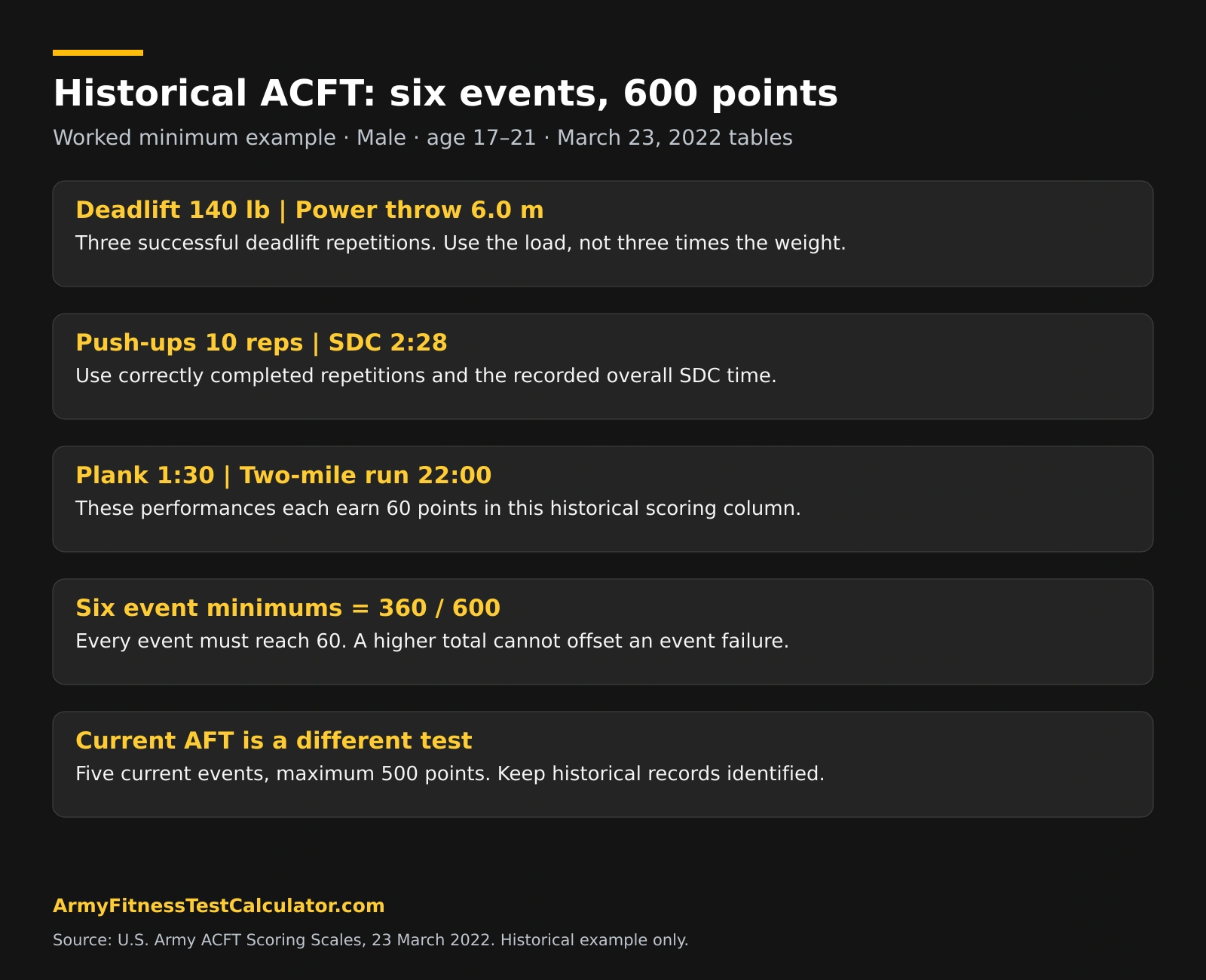
A male Soldier in the 17 to 21 group earns exactly 60 points in each event with these performances under the selected historical tables:
| Event | Recorded performance | Historical points |
|---|---|---|
| Three-repetition maximum deadlift | 140 lb | 60 |
| Standing power throw | 6.0 m | 60 |
| Hand-release push-ups | 10 repetitions | 60 |
| Sprint-drag-carry | 2:28 | 60 |
| Plank | 1:30 | 60 |
| Two-mile run | 22:00 | 60 |
| Total | Every event minimum met | 360 / 600 |
These are the minimum performances for this particular column. Another age group or scoring column can have different raw thresholds for the same 60 points.
Now suppose five events earn 100 each and the run earns 59. Your total would be 559, but the run would still fail. The event breakdown makes that visible beside the combined score.
Understand the difference between ACFT and AFT results
The current Army Fitness Test has five scored events and a maximum of 500 points. The Army replaced the ACFT with the AFT on June 1, 2025, removing the standing power throw. The official Army AFT guidance explains the current test.
A 450 on an old six-event record therefore describes a different total from 450 on a current five-event record. You also need the correct event tables when scoring raw performances.
If you want the subtotal after removing old standing power throw points, the ACFT-to-AFT subtotal comparison tool performs that arithmetic. It doesn't create an official current score. For today's five-event performances, use the current AFT calculator.
Keep the archived result with its source record
Your original event entries, test date, age group and scoring edition give you a useful reference for checking the calculated total. Start with the raw performances and units before deciding that the points are wrong.
For example, three successful deadlift repetitions with 140 pounds produce a 140-pound raw entry. You enter 140, rather than multiplying the weight by three. Likewise, a run written as 22:00 belongs in the minutes and seconds fields, not as 22 seconds.
Once the event entries agree, compare the points and total with the signed record. You can then bring a specific table row and performance to the staff responsible for that historical record.
Frequently Asked Questions
Can this calculator score a leg-tuck result?
No. The selected March 23, 2022 tables include the plank. A record with leg tucks needs the instructions and scoring version applicable to that older test.
Can I use it for an ACFT with a medical-profile alternate event?
This version requires all six primary events. It doesn't reconstruct historical profile rules or replace a missing event with assumed points. Retain the approved profile and original test instructions with that record.
Does 600 mean I have a current maximum AFT score?
A 600 is the maximum on this historical six-event scale. The current AFT has a 500-point maximum and its own scoring tables. Keep the test name and date attached to either result.
Does this website submit my old score to the Army?
No. The calculation runs in your browser without submitting an Army record. The breakdown helps you check your entries; the official record remains with the Army's authorized process.